Apologetics: Confirmation
6th Sunday of Easter (A)

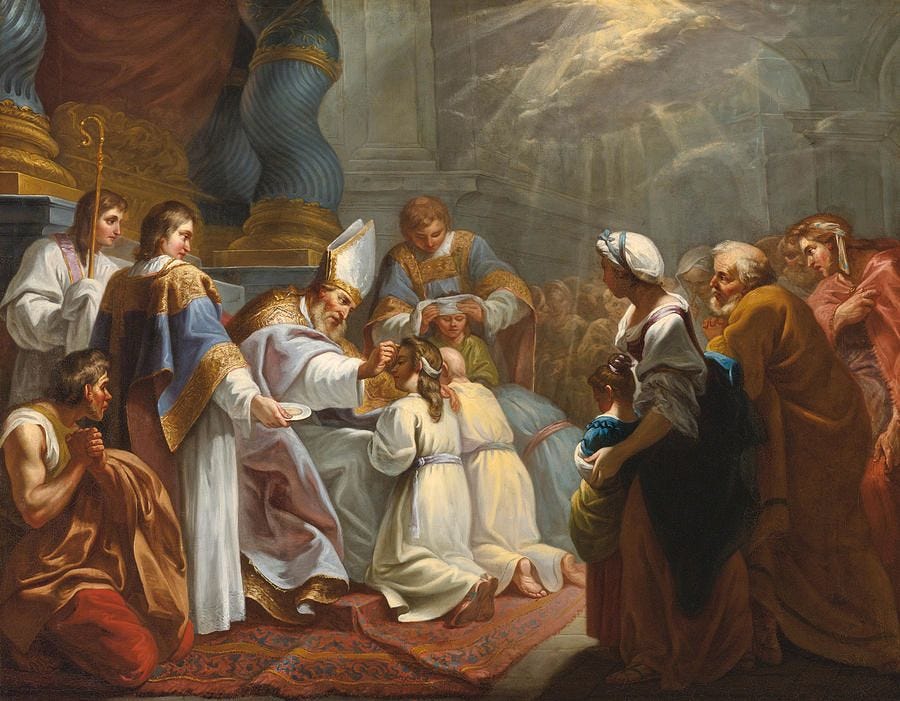
In the second reading, St. Peter tells Christians, “Always be ready to give an explanation to anyone who asks you for a reason for your hope” (1Pt 3:15). A Christian is called to testify and give witness, to explain and defend the truth which comes from God.
A few Sundays ago, the Gospel told of Jesus giving the power to forgive sins to his apostles (Second Sunday of Easter, Jn 20:23). This is an important Scripture verse for explaining and defending the Catholic faith, since only in the Catholic Church do you find the Sacrament of Confession, by which this power of Christ is exercised. Today, the readings show another important way in which the Catholic Church – and not the other Christian denominations – remains faithful to the apostolic era, and this is the sacrament of Confirmation.
Confirmation is a special sacrament, distinct from Baptism, in which the Holy Spirit is given to the faithful in a special way. Jesus spoke of this at length during the Last Supper: “I will ask the Father, and he shall give you another Paraclete, that he may abide with you forever. The spirit of truth, whom the world cannot receive because it sees him not, nor knows him: but you shall know him; because he shall abide with you, and shall be in you” (Jn 14:16-17).
Jesus speaks of the Holy Spirit being given as a gift to his followers, and through this abiding of the Holy Spirit in our souls, Jesus himself will be present and alive in us, as well as the Father (Jn 14:19-20). The Spirit will teach and remind us all things taught by Christ, and will enable us to act in his Name.
The Holy Spirit came upon the first disciples powerfully a the time of Pentecost, and then subsequently He is poured out upon Christians following Baptism, typically immediately after.
But in the first reading, the Acts of the Apostles tells of a situation where Confirmation was delayed, a practice that is now the common one.[1] The reason for the delay is the requirement that Confirmation be administered by one who has apostolic authority.
Philip, who went down to Samaria to preach Christ (Acts 8:5), is one of the seven deacons ordained by the Apostles to assist them in the ministry (Acts 6:1-6).[2] A deacon is given a limited share in the apostolic authority, something which continues to the present day. For instance, deacons can preach and perform Baptisms, but they cannot forgive sins or celebrate the Eucharist.[3]
Confirmation, on the other hand, requires a higher apostolic authority. For this reason, “when the apostles, who were in Jerusalem, had heard that Samaria had received the word of God, they sent unto them Peter and John” (Acts 8:14).
The following verses then make clear that Confirmation is indeed a second sacrament, distinct from Baptism: “[the apostles] prayed for them that they might receive the Holy Spirit; for the Spirit had not yet fallen on any of them, but they had only been baptized in the name of the Lord Jesus. Then they laid their hands on them” (Acts 8:15-17).
It is the bishops today who, as successors of the apostles, are the primary ministers of Confirmation. When the bishop came to our parish last week, this is exactly what he did. He prayed over the candidates, laid hands on each of them, and anointed them with the words, “Be sealed with the Gift of the Holy Spirit.”
Most of the non-Catholic denominations reject the Sacrament of Confirmation, looking to Baptism alone for the fullness of Christian life. And even those denominations which do have some type of “Confirmation” ceremony (Episcopalians, Lutherans, Methodists, Presbyterians), do not have true bishops ordained in the Apostolic Succession.
Confirmation, then, is one more key reason why the Catholic Church is the true Church established by Jesus, faithful to the practices of the early Church.
During these final days of the Easter season, let us pray for the coming of the Holy Spirit, that he may “stir into flame” again the gifts we received through our Confirmation (cf. 2Tm 1:6).
[1] In the Latin Rite of the Catholic Church, Confirmation is delayed until adolescence. In the Eastern Rites, Confirmation is celebrated at the time of Baptism, even for infants. In the West, that practice is followed when an adult is Baptised at the Easter Vigil.
[2] Not to be confused with Philip who was one of the Twelve Apostles.
[3] Priests, on the other hand, are ordained with a greater share of apostolic authority, sharing in most of the functions that are performed by bishops, who alone possess the fullness of apostolic ministry as successors of the Apostles.