Aspiring Hope
Ascension of the Lord (A)

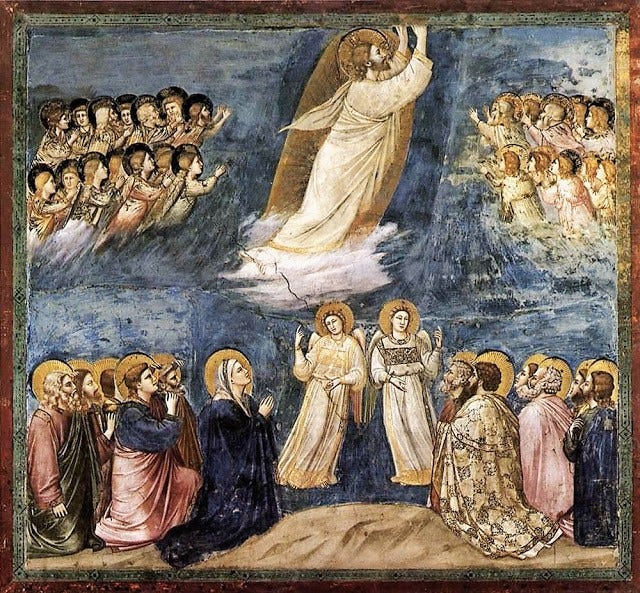
The Resurrection appearances changed the disciples by securing their faith, confirming all they learned from the Lord Jesus during his public ministry, especially his divinity. The Ascension sealed their hope, by indelibly imprinting the vision of heavenly glory on their souls, and Pentecost inflamed their charity, moving them to go out to their neighbor with the Good News of salvation.
The Ascension then, like the Resurrection, is a foundational experience which defines Christian spirituality. It is not only an event in the life and mission of the Lord, but an experience of the Church, which each Christian must have if he is to be a true disciple.
Christians live in the world like others, but are (should be) completely different in their manner of life, because their hope is fixed at the Right Hand of the Father in heaven. The Christian’s true home and citizenship is the Kingdom of Heaven, not that of earth. Christians live in the world as sojourners, pilgrims, missionaries. Their wisdom, understanding, knowledge, counsel, and piety are not worldly, but heavenly. Their understanding of sin, suffering, life, and death are not the same as others, having been transformed by the Cross.
By his Ascension, Christ “fixes” the vision of the apostles upon himself enthroned in glory at the Father’s right hand, with all things subjected under his feet (Eph 1:22). They literally watched him enter the heavenly realm (Acts 1:9), and then remained in that state until the angels brought them “back down to earth” (Acts 1:10-11).[1] Their physical eyes once again took up daily activities on earth as they returned to Jerusalem from the Mount of Olives to await the Holy Spirit (Acts 1:12), but their hearts and minds remained fixed interiorly from that day forward on the Ascension. That vision sustained them through all the upcoming difficulties as they carried the Gospel to “Judea and Samaria, even to the ends of the world” (Acts 1:8).
In the second reading, St. Paul eloquently proclaims this “Ascension Spirituality” of Christians: “The eyes of your heart [are] enlightened, that you may know what the hope is of the glory of his inheritance in the saints, and what is the exceeding greatness of his power towards us” (Eph 1:18-19). The Ascension inoculates us against the discouragement and darkness of the world, it prevents despair.
In the various Liturgical Solemnities of the Church calendar, all the mysteries of Christ’s life are celebrated and explained, and each of them can be found in every Mass. Every Mass brings us to the Nativity, to the Epiphany, to the Passion and Sacrifice of Calvary, to the Resurrection; and every Mass is the Transfiguration, the Ascension, and Pentecost…
Today we might ask, in what way is the Mass the Ascension? Where do we find this mystery of Christ being articulated in the liturgy? There are numerous places, such as the phrase “..who art in heaven…” when we say the Our Father, but none is more direct than the preface dialogue: “Lift up your hearts / We lift them up to the Lord.” The Mass is the Resurrection appearance of the Lord, but the Mass is also, equally, the lifting up of our minds and hearts from earth to heaven in the Ascension.
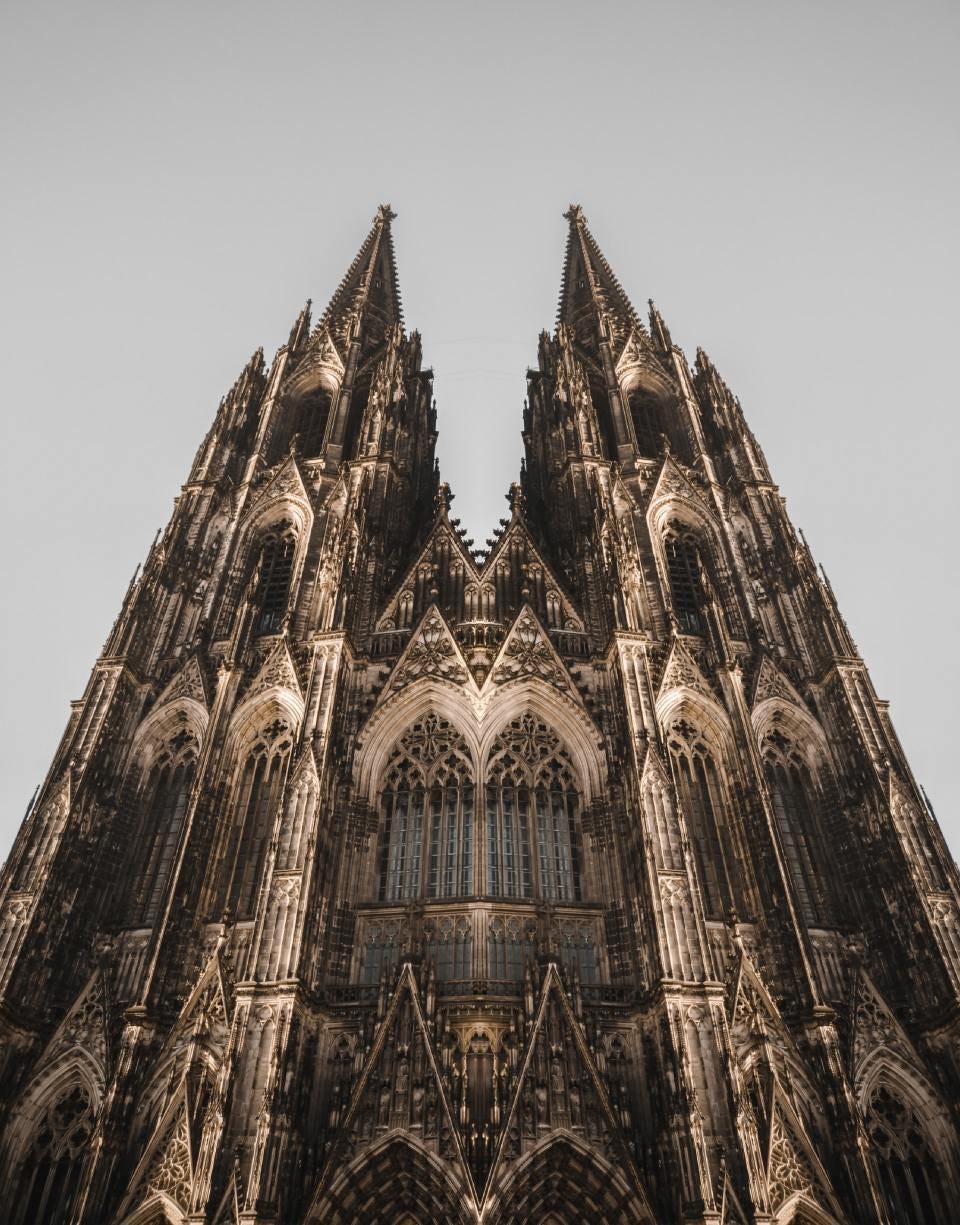
In medieval times Christians perfected the “spire” as an architectural feature of the church building. From a distance, the gothic churches always stood out in a town or city, by means of their spire pointing to heaven. As the faithful approach the main doors to enter the church, if they look up the spire will appear as a perfect “ladder” that goes up in infinite regression into heaven itself. This optical effect is not a coincidence, it is a concrete image of what a church is in its overall purpose, and exactly what is accomplished within it through the celebration of the liturgy. A church is a place where heaven and earth meet, where man is lifted up to God.
We come to Mass in order to be strengthened for our work in the world, without discouragement or despair. We go to church regularly to be sustained in that hope of which St. Paul speaks. If we stop “going to church” or abandon the practice of our faith, we immediately begin to sink back down to the earth, into the earth, under the earth. We become “mired” in sin, we “return to dust.” On the other hand when we are nourished spiritually by Word and Sacrament, the breath of God is constantly in us, and the image of Christ in full glory shines unimpeded within the soul.[2] The Mass equips us for the task of the Gospel today, as it equipped the apostles for their mission on the day of Ascension.
The “Mass” (Latin: “missa”) derives its common name from its concluding purpose, which is to send (missa = sent) the faithful into the world, having participated in the full Paschal Mystery of the Lord Jesus Christ. Thus it is that the church’s “angels” (the clergy), dressed in white robes, send us back from the holy mountain to our earthly lives, renewed in faith, hope, and charity: “Ite, missa est!”
[1] These are undoubtedly the same angels who have been with the Lord since his Resurrection on Easter Sunday (cf. Lk 24:4).
[2] The Sacrament of Confirmation.