Baptism
23rd Sunday in Ordinary Time (B)

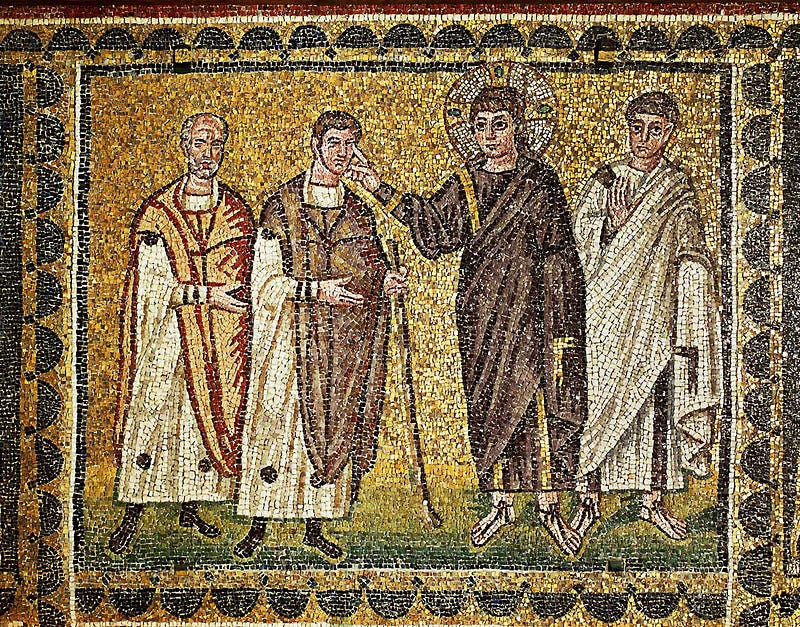
St. Mark wrote his Gospel in Greek, the common language of the Gentile world. But in this passage he retains the actual Aramaic word which Jesus spoke when he healed the deaf-mute man: “Ephphetha,” “be opened!”
Mark says Jesus groaned deeply, from the depth of his spirit, when he spoke this word. He also tells us how Jesus put his finger into the man’s ear and touched his tongue, using his saliva. In the beginning, God spoke and the world was made, and God formed man from the clay of the ground, putting His own breath and Spirit into the clay so that man would be a living being (Gn 2:7).
Jesus, the eternal Son through whom the Father first made man, now puts his finger into the man’s ear to reform the clay, and puts his own life into the man so that he will live, and hear, and speak. This is the same thing Jesus said he would do through the Eucharist: unite himself with us, even on the physical level, so that we would then have in our flesh his Flesh, and in our blood his own divine Life. But Jesus first does this in Baptism.
Jesus continues to speak this word, “Ephphetha,” every time we celebrate baptism. At the end of the ritual, after the anointing and white garment and candle, the priest traces the sign of the cross over the child’s ears and lips saying, “The Lord Jesus made the deaf hear and the dumb speak. May he touch your ears to receive his word and your mouth to proclaim his faith, to the praise and glory of God the Father.”
In Baptism, God re-forms and re-creates us as a new man, possessing of divine life. Our nature is regenerated. And one of the special graces we have as Christians, through Baptism, is the grace to hear and speak God’s word.
This is not something we can accomplish by human power. The ears we are born with cannot hear heavenly speech. God’s language is above us, and it takes a gift of grace from the Holy Spirit to enable these ears to hear it.
This grace is ongoing. Many Catholics remain spiritually “hard of hearing” all their lives. When teaching parables, Jesus would regularly use the phrase, “Let him who has ears to hear, hear!”
We often fail to hear, even though God is speaking. The world drowns out His voice. Elijah didn’t hear God in the great fire and earthquake, but in the gentlest breeze (1K 19:11-13). Elijah had to travel into the wilderness before he could achieve the silence that enabled him to hear that Voice. Like the deaf and mute man, we too struggle.
The miracle of Jesus is two-fold. From hearing comes speaking. If we do not hear God, it’s no surprise that we also don’t proclaim Him. We also need Jesus to touch our tongue and open our lips, in order to fully live this new life given in Baptism.
Let us ask the Lord to speak this powerful word, “Ephphetha,” over us today, that we might be healed and fully present to the divine conversation taking place in our lives.