Christian Morality
6th Sunday in Ordinary Time (A)

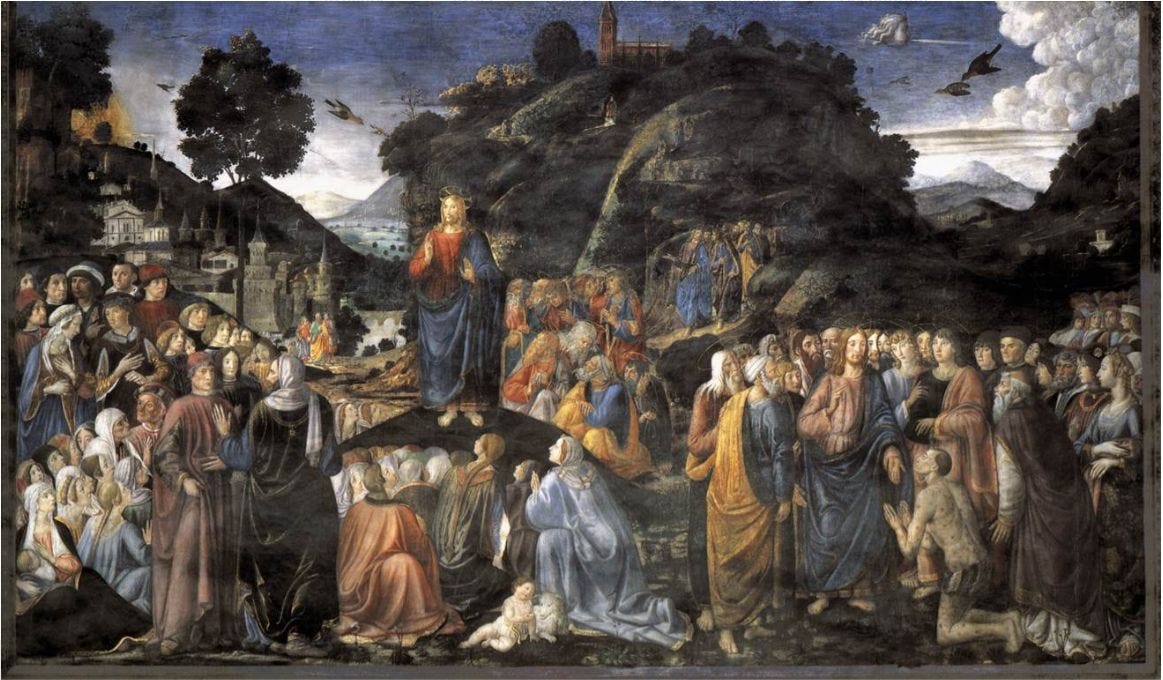
The Pharisees rigorously observed every commandment of the Law of Moses, down to the smallest detail, whether this meant purifying one’s hands before eating, avoiding work on the Sabbath, respecting God’s holy Name, or fulfilling oaths. They were very zealous to do right.
In the Sermon on the Mount, Jesus also emphasized that his followers must keep the law in all its fullness, down to the “smallest letter.” But then he says, “I tell you, unless your righteousness surpasses that of the scribes and Pharisees, you will not enter the kingdom of heaven” (Mt 5:20).
Jesus proceeds to explain how his followers will observe the law in a way even greater than the Pharisees. He wants them to be strict, but not in the Pharisaical way, where the goal is external conformity. In some things Christians are actually not as strict as the Jewish Pharisees (for instance with regard to dietary rules). In other more important ways, however, Christians are to be stricter.
For Jesus, the importance of the law is the way it must exist within, written on the heart. Even though the law will be revealed by external conformity of one’s actions to the law, holiness or righteousness is not found in that external observance of the law, but only in the love and purity of the heart which acts in a just way. In other words, our external actions – the way we keep or fail to the keep the various precepts – must flow from a heart that is holy, from a spirit that is right. As the Pharisees of Jesus’ day demonstrated again and again, it is entirely possible to be one thing on the outside, but something totally different inside. “Woe to you, scribes and Pharisees, hypocrites! For you are like whitewashed tombs, which outwardly appear beautiful, but within are full of dead men’s bones and rot” (Mt 23:27).
In order to illustrate his teaching, Jesus uses three examples, based on the 5th, 6th, and 8th Commandments. In each case, Jesus focuses on the interior person. With regard to the fifth commandment – “You shall not kill” – Jesus says we must not even harbor anger. With regard to the sixth commandment – “You shall not commit adultery” – Jesus says we must not even harbor impure thoughts. And with regard to the eighth commandment – “You shall not swear falsely” – Jesus says we must not even say anything beyond “Yes” or “No.” In other words, we are always to be honest, true, and faithful.
In his teaching, Jesus redirects us from the “big” and obvious sins (committing murder or adultery, lying under oath), to the “little” things which are more serious than we realize (calling your brother a bad name, indulging in a lustful fantasy).
With regard to these “little” things, Jesus is severe. Merely calling your brother “Raqa” (i.e., “you idiot!”) merits going before the council of the Sanhedrin! And merely looking at another woman lustfully merits having your eye gouged out and your arm cut off! For Jesus, the little things are the big things!
He also emphasizes this truth when he urges his followers to “settle with your opponent now” before coming to the judgment on the last day (Mt 5:25). Because on that day, there will be no escaping the just Judge, and any unsettled debts will require us to be handed over to prison until we have paid the last penny. This is how Jesus teaches the existence of Purgatory. Jesus makes clear, there is no escaping the demands of the moral law in its entirety, down to the smallest letter. What is still left undone at the end of this life, must be completed in the next, before the peace of heaven (beatitude) is possible.
Christian morality is demanding indeed. It sets an absolute standard for the children of God, because they are the children of God. Jesus will conclude this section of the Sermon on the Mount dealing with morality with the exhortation: “Be therefore perfect, as your heavenly Father is perfect” (Mt 5:48).