Confirmation
Baptism of the Lord (A)

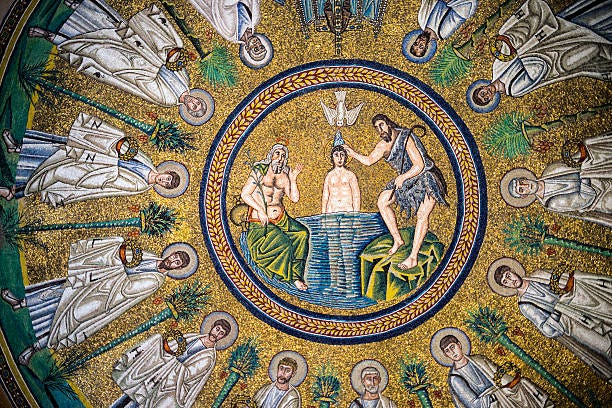
By receiving John’s baptism, Jesus is preparing the Sacrament of Baptism for his Church. He receives the washing of baptism not because he is a sinner in need of cleansing, but in order that those waters might have actual power to cleanse sin, and not be merely symbolic.
But Jesus is also preparing for the Sacrament of Confirmation. There are two distinct parts to his baptism in the Jordan: first is the washing in the river. After this (Mt 3:16), the heavens are opened and the Holy Spirit descends upon him in the form of a dove. It is this second part that corresponds with Confirmation.
Confirmation is not part of Baptism, as Martin Luther teaches. Though it does complete what Baptism begins, it is something separate and distinct. Acts of the Apostles documents how after Christians were baptized by the deacon Philip in Samaria, the Apostles Peter and John had to come down and Confirm them, because though baptized, “they had not yet received the [anointing of the] Holy Spirit” (Act 8:14-17).
Baptism is the sacrament by which sin is washed away, especially original sin. It is the sacrament of rebirth by which we become children of God and receive the Name of Christian. Through Baptism we become temples of God, and dwelling places of the Holy Spirit. We inherit the Kingdom of God, and receive the gift of salvation.
Why then, do we need this other “anointing of the Holy Spirit,” if we already receive all the graces of salvation in Baptism, including the Holy Spirit? The best way to appreciate the distinctiveness – and need – of the second sacrament is to follow the analogy of infancy vs. adulthood. Baptism makes us children of God, while Confirmation brings us to spiritual adulthood in the faith.
The fullness of human life is not found in the infancy of a newborn infant, but rather in the adult who exercises the full powers and capabilities of the human nature. Parents look for the day when their babies can come into their full responsibility as adults. Likewise, God looks for his children to fully engage in the work of establishing His Kingdom. It is for this mission that the anointing of the Holy Spirit is given.
The anointing is seen first in Jesus. It is what makes him “Christ.” In the synagogue of Nazareth, Jesus quoted the prophet Isaiah to explain how “the Spirit of the Lord is upon me; He has anointed me to bring glad tidings to the poor, liberty to captives, and usher in the jubilee year of the Lord” (cf. Lk 4:17-19). It is the anointing of the Holy Spirit that enables Jesus to carry out his good works, healing those oppressed by the devil, and working miracles (cf. Acts 10:38).
Far from being “secondary” to Baptism, Confirmation is the goal of Baptism. It is in order to be able to accomplish great works in the name of God that we are first cleansed of sin and blessed with divine adoption.
In the anointing of the Holy Spirit, we receive the “Seal” of the living God (cf. Rv 7:3,[1] Rv 14:1,[2] 2 Cor 1:21-22,[3] Jn 6:27[4]). This seal is His Name, His authority, His identity. Through it we can act with the Power of God, according to His Wisdom, Knowledge, Understanding, Counsel, Fortitude, Piety, and Fear. In short, we can be like Jesus, and do as he did.
Far from being a sacramental “step-child” relegated to secondary status, Confirmation is indispensable to the life and mission of a Christian, who like Jesus is called to establish God’s Kingdom in truth and power.
[1] I saw another angel ascend from the rising of the sun, with the seal of the living God, and he called with a loud voice to the four angels who had been given power to harm earth and sea, saying, “Do not harm the earth or the sea or the trees, till we have sealed the servants of our God upon their foreheads.” (Rv. 7:3)
[2] Then I looked, and lo, on Mount Zion stood the Lamb, and with him a hundred and forty-four thousand who had his name and his Father’s name written on their foreheads.(Rv 14:1)
[3] But it is God who establishes us with you in Christ, and has commissioned us; he has put his seal upon us and given us his Spirit in our hearts as a guarantee. (2 Cor 1:21-22)
[4] Do not labor for the food which perishes, but for the food which endures to eternal life, which the Son of man will give to you; for on him has God the Father set his seal.” (Jn 6:27)