Culture
20th Sunday of Ordinary Time (A)

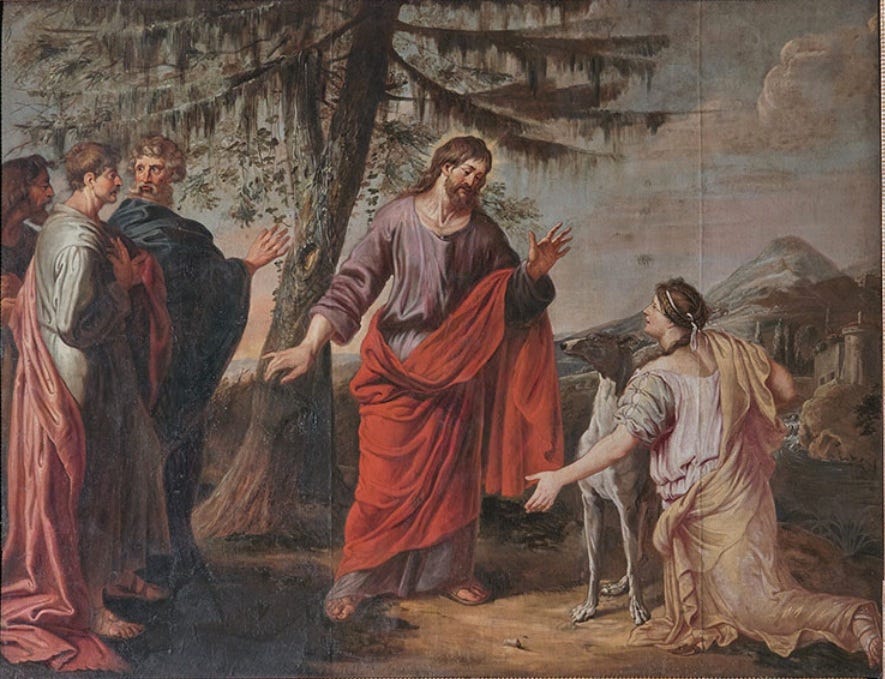
It is always shocking to see how Jesus treated the Canaanite woman when she requested help for her daughter. He does not seem to be very “welcoming” or “accepting,” not very “Christ-like” at all. Which is precisely why we need to reexamine and pay close attention to what Jesus is doing, because his actions are always deliberate.
On one level, Jesus is teaching the importance of humility when requesting anything from God. Before God we are beggars, and must approach Him on His terms, not ours. On another level, however, this is an issue of “culture,” and the relationship of Gentile culture to the nation of Israel, God’s “Chosen People.”
Jesus had a very specific focus in his public ministry, which was the restoration of the House of Israel, and the proclamation of the Kingdom of God. This is the first part of his mission. Only after the Resurrection would the Gospel go out to all the other nations, now that they could be incorporated and grafted into a reestablished holy nation, the Church.
In order to accomplish the first part and restore the kingdom of David his father, Jesus sought out all the “lost sheep of the house of Israel” (Mt 15:24). In Jesus’ day, the only tribes of Israel which still had significant numbers were in the south: Judah (“Jews”), Levi (Levites around Jerusalem who ministered in the temple), and Benjamin (tribal region bordering Judah whose land included the city of Jerusalem.[1] It was for this reason Jesus centered his public ministry in Galilee, in the north, and why in today’s Gospel he was traveling through a very pagan area of the north, Tyre and Sidon (Mt 15:21). He was looking for any people who belonged to the old tribes that history had largely scattered (such as Zebulun, Asher, Naphtali), in order to announce to them the restoration of the new Kingdom.
The Kingdom of Israel was a unique nation in the history of the world, by origin and culture, in that it was directly, immediately, and personally created by God Himself. This is all laid out in the Old Testament, especially the Law of Moses, which sets forth not only the moral precepts of the Ten Commandments, but also the rules of liturgy and worship, economics, legal-justice, education, public health and welfare, marriage and family life, even personal hygiene and diet. The Law of Moses is an entire culture and way of life, and it is superior to all others. God’s Chosen People stood out among the nations of the world for their wisdom, well-being, and holiness: “What great nation is there that has a god so near to it as the LORD our God is to us, whenever we call upon him? And what great nation is there, that has statutes and ordinances so righteous as all this law which I set before you this day?” (Dt 4:7-8).
God created a “culture” in which people could flourish under His personal providential guidance. When they strayed He punished them, but when they followed His precepts He blessed them abundantly. Only through His Law did people live according to their true dignity as children of God, in a society that was truly just and correctly ordered. In all other nations and cultures, people were subject to cruelty and oppression, ignorance and superstition, and all the dark forces of demons. It is no surprise the Canaanite woman’s daughter is possessed by a demon: the culture literally worships demons in their religion dedicated to the idol Baal. Demons are the Canaanite way of life. Their society is one of depravity and immorality, cruelty and injustice.
Therefore, Jesus is only able to help the woman when she acknowledges the superiority and holiness of the Covenant People, the House of Israel. By acting this way, Jesus gives a foreshadowing of the future work of the Church in evangelizing nations. In order to become Christian, people must renounce their pagan culture, and adopt the way of the Bible. Even if they do not get circumcised and follow the other precepts of the law with regard to worship and diet, since that is now fulfilled in the new priesthood, Temple, and sacrifice of Jesus, they still have to adopt for themselves the culture and way of life established by God for His children in the Bible. The Old Testament continues to be part of the Christian Bible, because it is the template for Christian culture, the culture of the “New Israel.” Evangelization, then, is not simply personal belief, but social reform.
All Gentile nations have to submit their cultures to a purification process that acknowledges the superiority of the culture of God’s Kingdom, which He brought into the world in the Old Testament, and which sits in judgement over their beliefs and practices. All nations have to be pruned and grafted in to this new Israel. Thus it was the Roman and Greek converts to Christianity had to adopt new ways, and reject with abhorrence the violence, immorality, idolatry, and depravity of their Dionysian, Apollonian, Venal, Martial culture. Likewise the Celts had to reject the Druidic rites, and the Aztecs had to abandon the bloody culture of human sacrifice.
We are not sent into the world that it might change us; but that we might change it. We are not to throw the food of children to the dogs, but rather show that in order to eat Bread at God’s table, people must live in the dignity of God’s children. Evangelization brings about a new culture and civilization of light and life, in which the forces of darkness lose their dominion. Conversely, the loss of Christian culture in our own day is immediately accompanied by a resurgence of demonic activity, a culture of death, and the old totalitarian forces that seek to re-enslave mankind.
If we wish our sons and daughters to be free of demons, we cannot engage in the sordid immorality and indecency of modern society. We cannot be formed by the corrupt and atheistic educational establishment. We must reclaim and re-immerse ourselves in the glorious Christian heritage and tradition of our western civilization, built up through many centuries of faith, and lived out in the example of so many great saints. This is the true culture of life, the true civilization of love for which we were created.
[1] We tend to use the word “Jew” and “Jewish” loosely to refer to the entire Old Testament heritage, since it is largely “Jews” who survive today. However, Jews were only one of the twelve tribes of the House of Israel. Jesus himself was a Judahite (Jew), descended from the royal Davidic line, whose clan lived in Bethlehem. John the Baptist was a Levite, not a Jew. St. Paul was also not Jewish; he was a Benjaminite (cf. Phi 3:5).