Dies Irae
Solemnity of Christ the King (A)

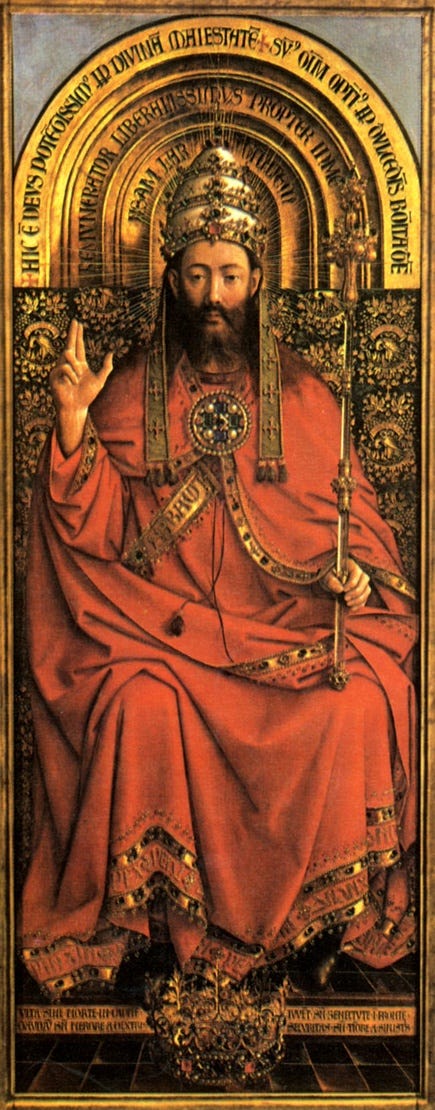
When we began the men’s “Schola” in the parish four years ago, the first Latin chant they learned was the “Dies Irae,” a medieval poem in nineteen verses, that meditates on the Last Judgement. This prayer highlights both the severity of God’s justice, and the extent of His mercy in sending His Son to die for man’s salvation.
For centuries, the Dies Irae was used as a “sequence” in the funeral Mass, and many classical composers made it the centerpiece of their greatest works.1 Today unfortunately it is hardly ever heard. In our parish, the Schola sings the Dies Irae on All Souls Day, Ash Wednesday, and Good Friday.
Today we come to the end of the month of November, during which we have remembered the dead and turned our attention to the “Last Things,” especially death and the final judgment. The liturgical year now culminates with the celebration of the universal Kingship of Jesus Christ, whose dominion will be fully revealed on the Day of Judgment when he “comes again to judge the living and the dead,” and when the last enemy, death, will be destroyed (1 Cor 15:26).
Because the Dies Irae makes so many references to the Gospel of today, where Christ the king (Mt 25:34) is seated on his throne for judgment (Mt 25:31), and who separates the sheep from the goats (Mt 25:32), I thought it fitting therefore to close our Church liturgical year by hearing anew the words of that beautiful ancient prayer.
O day of wrath, that terrible day,
when the world will be reduced to ashes:
as prophesied by [the psalms of] David and also the [pagan] Sibyls
How great will be the trembling,
when the Judge arrives,
to rigorously examine all things!
The trumpet, scattering a wondrous sound
through the regions of sepulchres,
will summon all before the throne.
Death and nature will both be astounded,
when the creature rises again,
to answer before the Judge.
The book will be brought forth,
in which is written everything
for which the world is to be judged.
When therefore the Judge will be seated,
all that is hidden will be revealed:
nothing will remain unpunished.
What then shall I say, poor wretch that I am?
Which patron shall I entreat,
when even the just are not secure?
King of fearsome majesty,
Who freely save those to be saved,
save me, O fount of mercy.
Remember, merciful Jesus,
that I am the cause of Your journey:
may I not be lost on that day.
You wearied yourself in seeking me,
To redeem me, you suffered the Cross:
let not such labor be in vain.
Just and avenging Judge,
Give the gift of [sin’s] remission
before the day of reckoning.
I sigh, as one guilty:
my face reddens in shame:
spare the one imploring you, O God.
You Who absolved Mary [Magdalene],
and heard the plea of the [dying] thief,
have also given me hope.
My prayers are unworthy:
but You, Who are good,
graciously grant that I not perish in the everlasting fire.
Grant me a place among the sheep,
and take me out from among the goats,
setting me on the right side.
When the wicked are confounded
and given over to bitter flames,
call me to be with the blessed.
Humbly kneeling and bowed down I pray,
my heart contrite in ashes:
guide me safely to my final end.
How tearful that day will be,
when from the glowing embers will arise
this guilty man who is to be judged:
Then spare him, O God!
Merciful Lord Jesus,
grant them rest. Amen.
Among the more famous settings of the Requiem Mass in classical music, particularly the “Dies Irae” are those of: