Faith and Sight
4th Sunday of Lent (A)

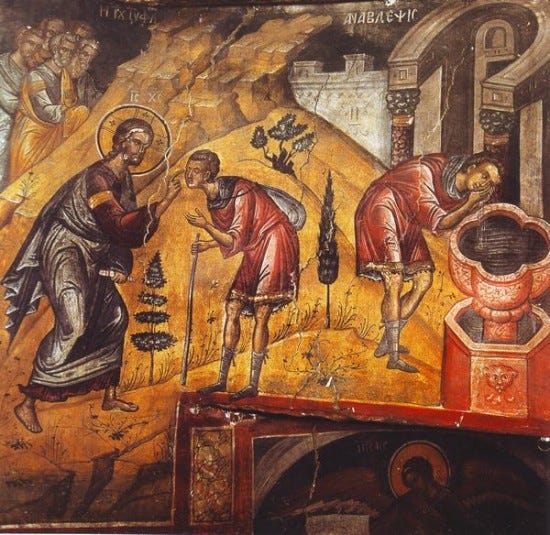
“Lord, who is the Messiah, that I may believe in him?” Jesus says, “You have seen him” (9:36-37). Jesus came into the world so that the blind may see, and those with sight might become blind. This gift of sight is an image of faith.[1]
The man born blind represents mankind born in a condition of Original Sin. Man is born as a beggar, to a life of darkness, because he is without the sanctifying grace that unites him with God and completes his nature. Like the blind man, there is something missing: an empty hole where there should be grace and light.
The washing which gives the man sight represents Baptism, by which man is restored to God.[2] Through baptism we are no longer alienated from God, living in darkness. We are now “light in the Lord,” living as children of light (Eph 5:8). This is recalled during the baptismal rite when we receive the candle.
Having known the difference between not seeing and seeing, the man healed by Jesus is the perfect individual to know what the gift of faith is. People who have always been able to see don’t necessarily appreciate what a gift their sight is. And for the same reason, people who think they “see” and understand everything about God are often the ones who appreciate the least what faith is.
Jesus encountered this with the Pharisees, who represent the tendency to deny Original Sin. We are born without grace (“blind” so to speak), but we like to pretend or delude ourselves that it is not really the case. To admit Original Sin is to admit the need of a Savior, but we don’t really like to admit that, because we prefer being our own saviors. The Pharisees, in their quest for holiness, have everything arranged according to a manageable understanding of the Law. They are so tied to their vision that they end up being spiritually blind, unable to recognize or accept the Messiah they’ve supposedly been waiting for.
We are not comfortable when our human reason only takes us so far, and in order to go further in our journey to God we have to take a step in faith. Like the doubting Thomas, we live by the phrase, “seeing is believing.” As long as I see something and fully understand it, I’ll go along with it. But Jesus reveals another side of faith. In order to see and understand, we must believe; it is not “seeing is believing,” but rather “believing is seeing.”
Faith is the gift that allows us to see. Faith is what sheds light on our experience. It guides and explains. Faith allows one to know what lies beyond, and see the bigger picture of his life. We like to see everything first with our reason before we commit ourselves. Yet St. John tells us that for the big questions it is only faith that will allow us to see.
But he is not talking about a blind faith, or some kind of rash judgement that negates human reason. Faith is illumined by real content. It’s not enough to trust and believe in just anything or anyone. Human reason still helps one find what to believe—it prepares for faith.
The man born blind had good reason to put his faith in Jesus: “It is unheard of that anyone cured a man blind from birth. He is from God. In him I will believe.” Thus faith is not blind, but informed by some content. Even when someone is born with eyes that function properly, he still wouldn’t be able to see without light. We can have eyes like an eagle, but if it is dark, we will still be blind. Besides the gift of sight, then, we need the presence of light in order to see.
And Jesus says that light is himself: “While I am in the world, I am the light of the world” (Jn 9:5) The faith of a Christian, received in baptism, is is not a blind faith, but one enlightened by someone. It is very specifically faith in Jesus Christ. Our faith allows us to see as we never saw before—to see truly and clearly things about our life, about God, and our destiny. This alone is the faith that saves.
So the Faith by which we are saved is not something we ourselves create or invent. It is not our particular human opinions about reality. Faith is something given as a gift in baptism, which we then seek to make our own through life, assimilating it, submitting to it, allowing it to guide and form us.
Most of us have been blessed with this faith since our infancy. This beautiful faith has been entrusted to the Church and has been handed on to each generation since the time of the Apostles. It is something lived out in the Church, and we recognize how it is bigger than any particular individual. It contains inexhaustible riches, and a wisdom that can transform life and society. Unfortunately, we often keep it on a shelf or in the closet: like some kind of family heirloom, which collects dust and remains unexamined and largely unappreciated.
But, whether our faith is still that of child who only touches the surface, or that of a contemplative who plunges into its depth, it allows us to look upon and recognize the features of our Lord. Already in this world, it starts to open for us the next. We profess it as our inheritance, because through it we will be saved and pass to heaven. Now we see dimly as in a mirror; then, face to face (1 Cor 13:12).
How does this gift of faith already make a difference? What does it allow us to see, that we could not see otherwise? The Gospel gives a few examples:
For one thing, faith gives a new meaning to Suffering. The disciples ask Jesus, “Who sinned, this man or his parents, that he was born blind?” (Jn 9:2) Jesus said neither; “it is so that the works of God might be made visible through him” (Jn 9:3). Faith allows us to see suffering in a different light, the light of Christ and his Cross. Reason cannot understand this, but faith tells us that suffering is not a punishment incurred because of our sin or someone else’s. Instead, it is a kind of redemptive service that contributes to the world’s salvation, when offered to the Father in union with Christ’s own suffering on the Cross. St. Paul will later say that “I make up in my own flesh what is lacking in the sufferings of Christ, for the sake of his Body which is the Church” (Colossians 1:24).
Faith also gives new meaning to Sin. It is not what pharisees think, when they look down upon the blind man as unclean because of his affliction. What faith tells us, which reason can never grasp, is that even the greatest sins are not an obstacle for God when we approach Him in humility and contrition. On the other hand, if we are self-righteous, even the smallest sins will remain unforgiven. How often did Jesus give parables to illustrate that “great love can cover a multitude of sins,” or that tax collectors and prostitutes will enter the Kingdom of God before the Pharisees.
Faith gives a whole new way of looking at Life itself. No longer do we speak of random coincidences taking place, or a blind fate governing our destiny. Faith allows us to see the Hand of God in all circumstances (why did this man have to be born blind?). Looking back at an event in our life through faith, we can begin to see the presence of God in the most unexpected and unanticipated ways.
Faith also allows us to see the meaning and purpose of our life, what our Mission is. Jesus made the man wash in the pool of “Siloam,” which the Gospel tells us means “sent” (Jn 9:7). Through faith we discover God’s call. Faith allows one to see things about himself he never saw before, especially the way in which he becomes part of God’s work in the world, helping Him bring in the harvest.
On the day of our baptism we were “washed in the pool of Siloam” and received the light of Christ. Have we allowed it to burn brightly? At Easter we will renew our Baptism promises. Do we try to see all things in its light? Like the blind man, we too have been blessed with sight. Can we say with him, “Lord I see you. I believe, and I worship”?
Let us stand and profess our faith.
Edward Elgar - from “The Light of Life”
[1] St. John found an excellent analogy for the mystery of faith in the act of “seeing.” When the Holy Spirit came down upon Jesus, John the Baptist “saw and testified that he is the Son of God” (1:34). When the first two disciples want to learn about Jesus he says, “Come and see” (1:39). When John came to the tomb on Easter Sunday and found it empty, the Gospel says he “saw and believed” (20:8). When Thomas saw Jesus risen from the dead, Jesus said he believed because he saw him, but “blessed are those who have not seen and have believed” (20:29).
[2] And the mud Jesus uses calls to mind the ashes of Lent, reminding us of our mortality: a preparation for baptism.