Give Me a Drink
3rd Sunday of Lent (A)

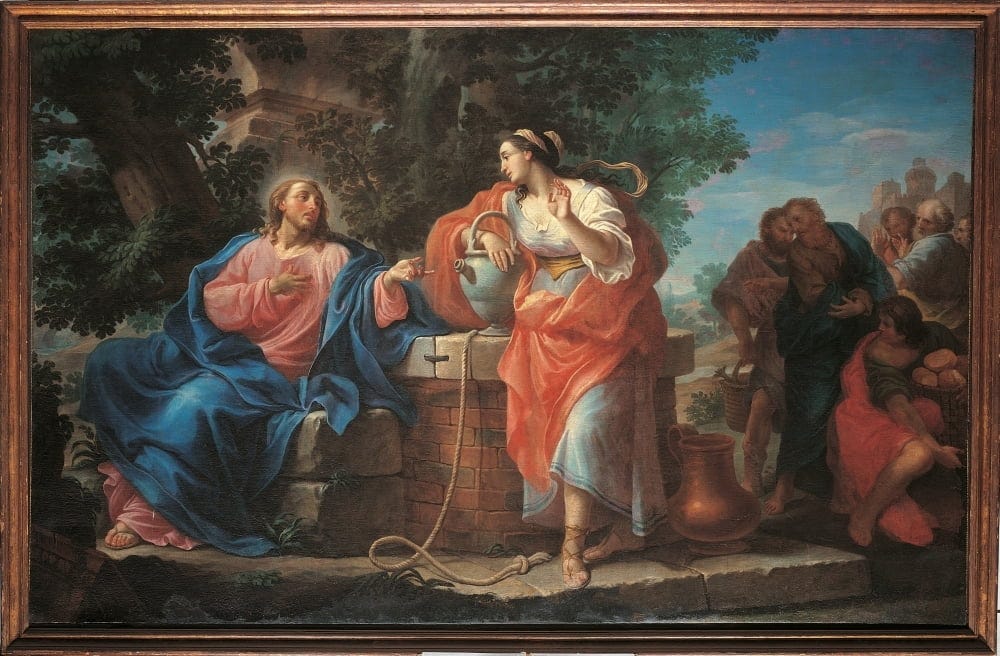
Like all the incidents in the Gospel of St. John, the story of the Samaritan Woman at the Well has many layers of meaning. It is the model story of evangelization: Jesus looks to the harvest of the Samaritans as the first fruits of his Church after Pentecost, since the Gospel will be preached “in Jerusalem and Judea, and then in Samaria, and then to the ends of the earth” (cf. Acts 1:8). Samaria is the territory of the “lost tribes” of the northern kingdom, which Jesus intends to restore in the future Church before going out to the other nations. The Samaritan woman is a type of the Church, which is assembled from Jews, former Israelites, and Gentiles.
On another level it is one of the great Gospel stories about Baptism. Jesus speaks of the “Living Water” he will give, that becomes in the soul a source of eternal life. Unlike ordinary water from a well, which is limited in its ability to satisfy thirst, this water which Jesus gives is the Holy Spirit Himself (cf. Jn 7:37-39).
All the various themes tie together, however, in the central Johanine theme of faith. The dialogue between Jesus and the woman represents the journey from non-belief to acceptance of salvation. It also illustrates the kind of relationship faith brings about: covenantal marriage.
At the beginning of the dialogue, there is skepticism and even hostility between Jesus and the woman: “How is it that you, a Jew, ask me for a drink?” (Jn 4:9). By the end of the conversation, she is a fully committed believer, with full knowledge, trust, and love. In the course of the conversation, she comes to know Jesus. Likewise, she learns that he knows her. In the course of the conversation, there is a discussion about true religion. Jesus indicates a clear superiority of the Jewish Old Testament religion over all other pagan religions[1] (Jn 4:22), but also the fulfillment of all religions in the new worship of Christianity. Like the Magi who found the true faith in Christ at Bethlehem, the Samaritan woman – and all those she represents – find their true faith and worship of the Father in Jesus the Christ, in Christianity.
This conversation between Jesus and the woman represents the “journey of faith” of every convert to Christianity, as well as the ongoing conversion of Catholics who may have been baptized at an early age, but never fully embraced the faith.
There is another layer of this story which is that of love and morality. Faith in Christ is love of Christ, the kind of love which is expressed in the fidelity of marriage. Prior to meeting Christ, the woman is given to immorality and infidelity as she “looks for love” in the wrong way, continually thirsty, never able to quench the thirst. Only Christ satisfies human thirst, so that we no longer sin by choosing lesser goods. This is symbolized at the end of the conversation by the woman abandoning her water jar at the well (Jn 4:28). She is able to abandon her previous life of sin because she has in received the “gift” of Living Water from the one who originally asked her for a drink. Christ too, has now been satisfied in his thirst because of her faith!
By initiating this conversation with a woman at a well, Jesus is echoing many biblical accounts of a man meeting his wife at a well. In biblical times the watering hole was a place for young men and women to socialize and court. Abraham’s servant met Isaac’s future wife Rebekah at a well (Gn 24:11-15); Jacob met Rachel at a well (Gn 29:1-11); and Moses met his wife Zipporah at a well (Ex 2:15-16). The woman was asked for a drink (Gn 24:14), and it was high noon (Gn 29:7). This is why the disciples are shocked when they see Jesus engaging in this behavior (Jn 4:27).
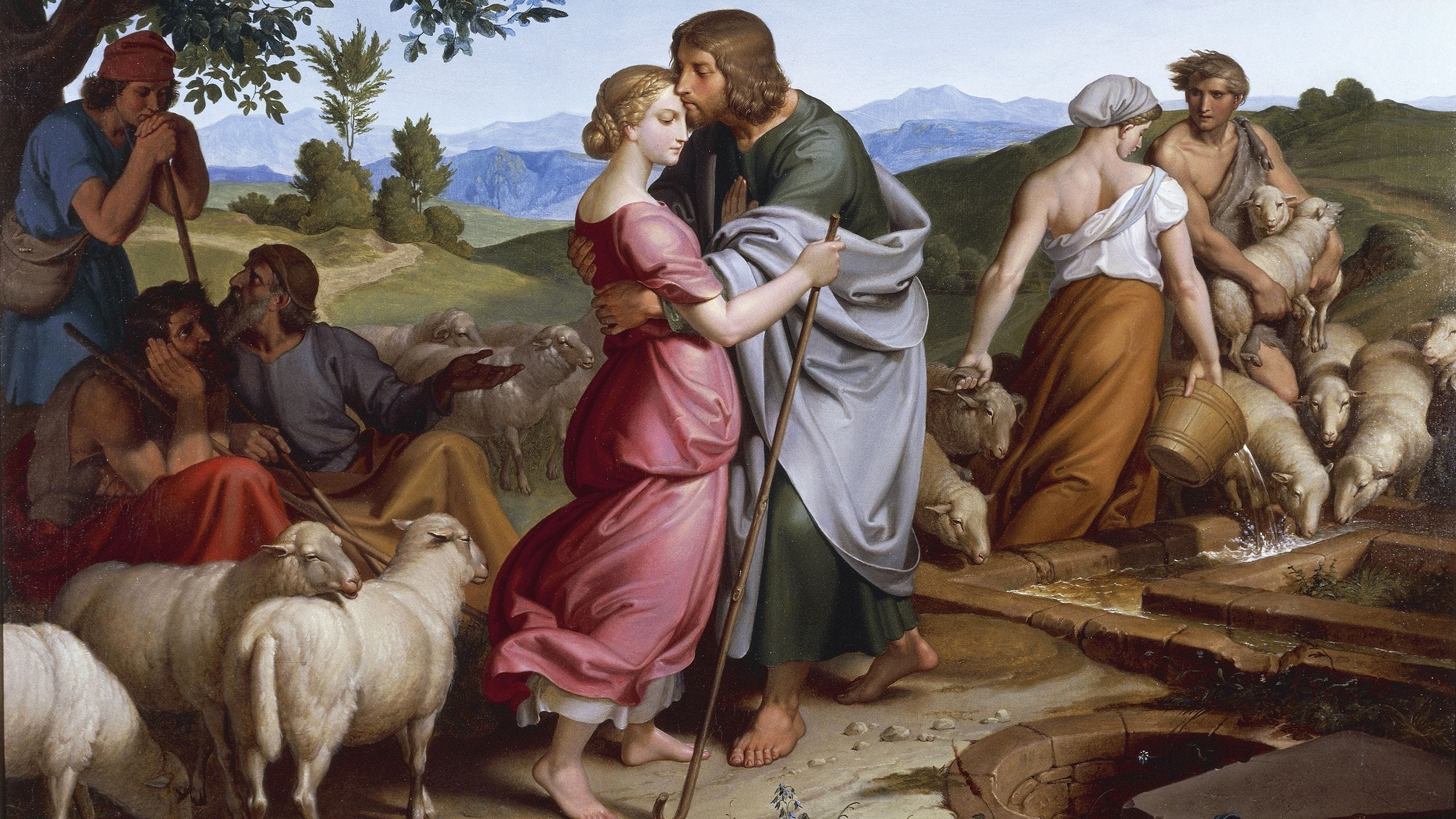
It is perhaps the most important aspect of the entire story. Why would Jesus deliberately situate the conversation of faith as a courtship dialogue? It is because “faith” is a love relationship of the highest order, deeply personal, total, mutual, and completely fulfilling. “Worship,” therefore, i.e., religion, must not be something mechanical, or simply cultural, because this is what one’s ancestors have always done (Jn 4:20). Religion must be in the fullness of truth (Jn 4:23), which one has come to know “for himself” (Jn 4:42).
As we continue our Lenten season in preparation for the renewal of Baptismal promises at Easter, let us reexamine our faith, and specifically the kind of relationship we have with Jesus our true “lord.” It is one of true love and loyalty, complete knowledge and commitment? If not, let us continue the conversation by which the two grow in their love, and finally satisfy their thirst.
[1] The “five husbands” (Jn 4:18) is likely an allusion to the five pagan “baals” – false gods – of the Canaanite peoples. “Baal” literally means “lord” or “husband.” The current Samaritan religion was an admixture of this paganism and Old Testament beliefs.