Glory
Feast of the Transfiguration (A)

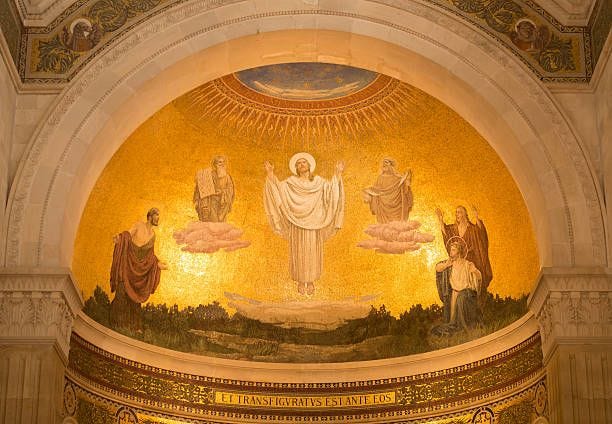
Many years after the Transfiguration, St. Peter writes of the event in his second letter, how he saw with his own eyes the majestic glory of the Son (2 Pt 1:16-18). What is this glory? What does it mean when we use that term, so common in the Bible and liturgy?
Glory is a light that shines from within, due to some goodness or praiseworthiness.[1] Glory is an effect of love: when one is loved by someone important, that is one’s glory. When one loves someone important, due to the goodness, beauty, and worth perceived in the person, and that love is received, the love causes that inner person to radiate with light, or brilliance.
This effect is perceptible even on a human level. For instance, when an infant perceives the love of his mother, his face “lights up with joy.” The pop singer Debbie Boone alludes to this glorious effect of love in her 1977 hit, “You Light Up My Life.” Glory is an effect of love, and there is no glory without love. Love increases life, expands the spirit, and brings forth the inner person in a radiant way.
If this is true even on a human level, what is divine glory like? On the mountaintop, Jesus invites his closest followers to experience his divine glory. The glory of Jesus is love of the Father. The Father is the glory of the Son, the Son is the glory of the Father, and the Holy Spirit is the glory of the Father and the Son. In the Transfiguration, Jesus reveals his inner life to be the Glory of the Holy Trinity. To experience the glory of Jesus, the apostles must experience the Holy Trinity. The “cloud” that “overshadows” them is the Holy Spirit, and the “voice” from within in the cloud is the Father. What He speaks is love for the Son: “This is my beloved Son with whom I am well pleased” (Mt 17:5). This love of the Father is the glory of Jesus, and now it radiates through him like the sun in brightness. His glory is absolutely overwhelming.
This glory of Jesus will also now be the glory of the Church, and it will radiate in the lives of the baptized, who are incorporated into Christ. God the Father will speak those same words of all who are “in Christ.” To “give God glory,” means we allow ourselves to be loved by the Father as Christ is loved, and love Him in return.
Heaven, then, will be the experience of divine glory. As long as he was in the flesh, Christ’s true glory was hidden or veiled by the mortal condition. It was always there, within him, but except for this one important moment of direct revelation, it was only perceived indirectly in his miracles and powerful words of teaching. The Transfiguration was a full glimpse and foretaste of the glory to come, given for the sake of strengthening the disciple’s faith and hope in the face of the Cross.
In heaven, the glory will be fully manifested for us as well, “shining like the sun in brightness” (Mt 17:2). But like Christ, while still on earth we must carry that glory within as a sure hope, something “…altogether reliable: You will do well to be attentive to it, as to a lamp shining in a dark place, until day dawns and the morning star rises in your hearts” (2 Pt 1:19).
[1] St. Augustine defines glory as clara noticia cum laude, “brilliant celebrity with praise.”