Gluttony
28th Sunday in Ordinary Time (A)

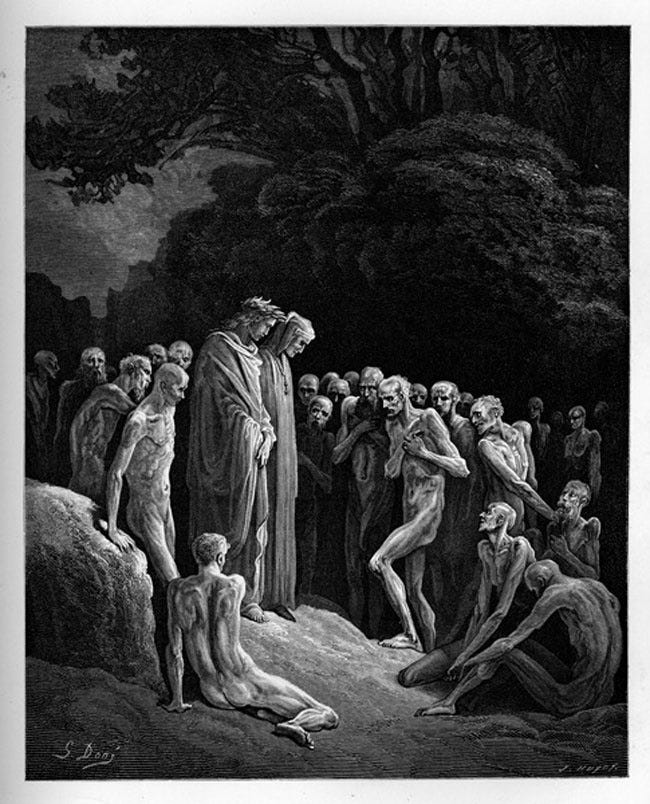
The readings for this Sunday speak abundantly of food! “On this mountain the Lord of hosts will provide for all peoples a feast of rich food and choice wines; juicy, rich food and pure, choice wines” (Is 25:6). In the Gospel Jesus compares the Kingdom of God to a wedding banquet: “Behold, the fattened calves are killed, and everything is ready; come to the feast” (Mt 22).
Yet Jesus also gives a warning: not everyone will be able to share that heavenly banquet. The king saw a man not dressed in a pure wedding garment, and threw him into the darkness outside, where he could wail and grind his teeth!
Today we can learn about another one of the seven capital sins, the sin of Gluttony. Gluttony, like Pride, Envy, Wrath, and the rest, is a deadly sin which will keep us out of the heavenly wedding banquet with God.
The simplest way to understand gluttony is “overeating,” one of its symptoms. But gluttony is more than that: it is a spiritual sin found deep in the soul, behind many of the other sins we commit.
Gluttony is related to eating. Man was created by God with hunger and thirst two levels: the body, and the soul. The deeper hunger is the spiritual one, the hunger of the soul for God. Strong as they are, bodily hunger and thirst are nothing compared to the emptiness the spirit without divine grace.
Gluttony means we try to satisfy spiritual hunger on the level of the body, materially. We eat and drink – or otherwise satiate ourselves physically – in order to “feel good,” solve problems, or assert control. Gluttony is a surrender of spiritual dignity to the animal appetites of the body, and the indulgence of those lower appetites as a path to happiness.
Typically, the capital sin of Gluttony is manifested by a tendency to overeat, or to eat only those foods that taste good. It is also manifested by the desire to drink too much and become inebriated, or indulge in drug abuse. But gluttony can also be found in the other direction: being overly finicky or pharisaical. Spiritual well-being should not be sought in the indulgence – or control – of the appetites of the body. Rather, the things of the body should be properly ordered to the spiritual goods. Meals should be an occasion of social enjoyment and ennoblement, not a Roman orgy of inebriation, nor an exercise of environmental veganism.
Jesus taught, “Man does not live on bread alone, but on every word that comes from God” (Mt 4:4), and “My food is to do the will of the Father” (Jn 4:34). Psalm 63 proclaims, “O God, you are my God, I seek you, my thirsts for you; my flesh faints for you, like a dry weary land without water.”
St. Paul teaches in the second reading: “In every circumstance and in all things I have learned the secret of being well fed and of going hungry” (Phi 4:13). Gluttony is conquered by Temperance, and Temperance is learned best by fasting, which orders human hunger to spiritual hunger, and acknowledges that material food cannot satisfy spiritual hunger.
Heaven is the spiritual banquet in which God nourishes the soul with Himself, and satisfies every desire and longing of the heart. Love is a “communion” in which all the angels and saints delight in the Lord.
Jesus provides this banquet already on earth, and we can participate already if we wear the proper wedding garment: if our heart is pure and our hunger is spiritual. We will have to conquer gluttony in order to experience the delights of this heavenly wedding banquet on earth. If we have our hearts set on the food or drink that satisfies now but leaves us hungry again in a few hours, we will never know the riches of the heavenly banquet.
The Mass is already “heaven on earth,” because in it we eat the Bread of Life. The reason it doesn’t feel like heaven for us, is due to our gluttony. Our lives become so sunk into our animal appetites, we can barely even fast for one hour before receiving Holy Communion, and even then we cut corners! Nothing seems to come between us and our food and drink. We will reluctantly drop a few dollars in the collection basket, and then readily spend double that at a restaurant afterward.
It is significant that Jesus gave us the richest gift of the Eucharist in the most humble food possible: very plain bread. We are so trained in the taste-good, feel-good approach, we can’t appreciate simplicity and poverty. And so we come to the wedding banquet wrongly dressed. Receiving Jesus in the Eucharist requires a fasting, because it requires serious spiritual hunger.
“Oh! Eternal God! You … fatten the soul with insatiable love, and though the soul is filled she is not sated, but ever desires You, and the more of You she has, the more she seeks -- and the more she desires, the more she finds and tastes of You” (St. Catherine of Siena)