Holy Eucharist
28th Sunday in Ordinary Time (C)

In our parish religious education program, to help teach the importance of Sunday Mass, the students must write out a prayer intention on a small card which they place in a sealed envelope and drop in the special basket during the offertory. This is a “homework” which parents must help them with. The goal of this activity is to help the students come to Mass each Sunday with a sense of purpose and commitment that is personal to them and their families.
There are upwards of ten thousand people living in our town and surrounding area, most of whom are baptized Catholics. Baptism is a cleansing from the worst leprosy of all, Original Sin. Yet how many are in Church this weekend? The words of the Lord in today’s Gospel, slightly adjusted, seem fitting: “Ten thousand were cleansed, were they not? Where are the other nine?” (Lk 17:17). Sunday Mass, the “Holy Eucharist,” is our “Thanksgiving” for the gift of Salvation which God has accomplished in Jesus Christ.
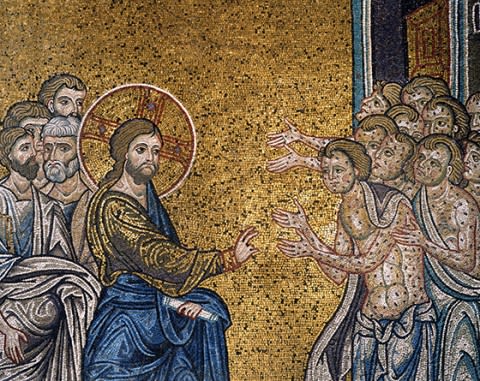
Jesus told the lepers to fulfill the precepts of the Law of Moses with regard to their condition, which included ritual sacrifices in the Temple and inspection by the Levitical priests (cf. Lv 13-14). In the Catholic Church of the New Testament, there are also ritual precepts to be fulfilled, including the Sunday Mass obligation. There is a great danger that these duties become “perfunctory,” done simply to fulfill a requirement, has happened with many people in the time of Jesus. That is not what our Lord intends the new liturgy to be. Instead, the Samaritan illustrates the true attitude, which is one of gratitude: “realizing he had been healed, he returned, glorifying God in a loud voice; and he fell at the feet of Jesus and thanked him” (Lk 17:15-16).
The Samaritan’s thanksgiving is personal, not perfunctory. He must go in person to give thanks. The Gospel also says that his thanksgiving is based on the awareness of God’s blessings: “one of them, realizing he had been healed, returned, glorifying God” (Lk 17:15).
If we take the time each day to recognize God’s blessings, and try to live each day by expressing thanks through good deeds, the need of the Mass will begin to make more sense. It is in the Eucharist that we are able to unite our daily acts of Thanksgiving with the perfect thanksgiving of Christ, through whom all blessings flow. The Mass is always personal. Above all, in the Eucharist we give thanks for the grace of salvation, which is the Baptismal healing of sin.
Like the students, let us take the time each week to acknowledge our needs, think about our blessings, and bring our deep personal gratitude to God in person, upon the altar of the Mass.