I Do Will It
6th Sunday in Ordinary Time (B)

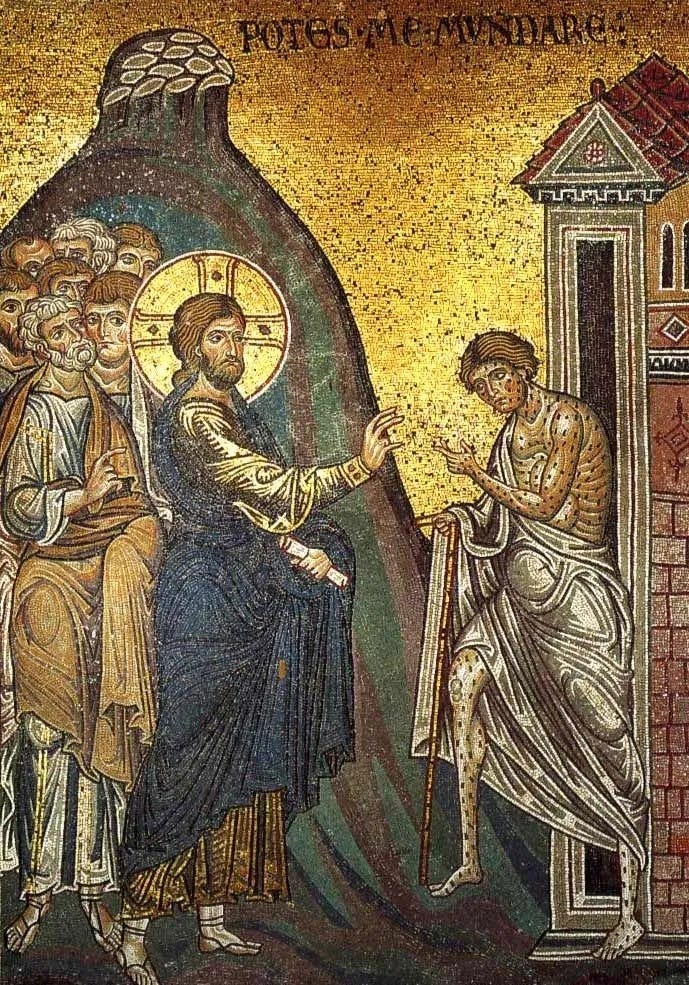
“I do will it. Be made clean” (Mk 1:41).
From the depth of his heart Jesus wishes to heal this man, who represents mankind in his fallen condition, under the curse of sin and death. Death is the punishment for sin, as we will remind ourselves on Ash Wednesday. But so is illness, which is the first assault on life’s power, and the beginning of the stages of death on the body. Jesus comes from heaven in order to conquer death, and the numerous miracles of healing are the sign of what he will accomplish by his Resurrection. He came that we might have life, to the full (Jn 10:10), and the first sign of this is the healing of the body.
Thus Jesus cures the leper of his disease. By touching the man, he imparts to him the increase of life which he possesses in himself. The leper’s body responds immediately. The healing is not limited to the body, however, and Jesus’ mission is not simply to end sickness. It is human nature that Jesus wishes to heal, cleansing the body, soul, and spirit (cf. 1Th 5:23) from sin.
In the Law of Moses, leprosy was not merely a physical malady, it was a symbol of fallen man’s uncleanness before God. On the surface, the leprosy laws of Leviticus (Lv 13-14) were a public health measure to quarantine the infectious and preserve the health of the community. But the isolation and “banishment” which resulted served as a public symbol of the alienation caused by sin. The Old Law is didactic.
Even today, illness is not merely a physical suffering, but also causes social harm, as it removes one from regular interaction with others. The sick person must take to bed, and stay home from work or school. The more serious or prolonged the illness, the more one loses social contact and suffers isolation and avoidance. For the elderly and homebound it amounts to a practical exile and banishment.
In the Law of Moses one is restored to social communion following an examination by the priest, and the offering of a sacrifice (Lv 14:2ff). This aspect of the man’s healing is stressed in Mark’s Gospel when Jesus directs him to fulfill these precepts (Mk 1:44). It is not enough for the body to be healed, the man must be restored to social communion, and readmitted to worship. Jesus came to cleanse man in his full human nature, and the healing he brings pertains to the body, soul, and spirit. Above all, it is the cleansing from sin (spiritual uncleanness).
The healing of the leper is most clearly echoed in the life of the Church in the Sacrament of Penance (Confession), whereby the sinner “shows himself” to the priest in order to be cleansed and reconciled to the Church.
By touching the leper, Jesus brings a “newness” that fulfills the Law of Moses and ends its didactic purpose. Jesus is not rendered unclean by touching the leper, which would be the case for anyone under the Law. Instead, the leper is rendered clean by the touch. Jesus brings something the Law does not possess, and which is greater than the Law; he brings the newness of the Kingdom of God.
The Church now continues with this charism of being able to touch the illnesses of man in order to heal and restore his nature. The sick are no longer alienated, but seen as integral members of the Church, who participate in her worship by means of their condition itself. This was the topic of the previous homily.
In the new covenant established by Jesus’ death and resurrection, sickness (and death) is no longer the curse or punishment of sin. It is now a penance. That is to say, it is a sharing in Christ’s suffering and death, infused with the grace of the Resurrection. Accepted as a sacrifice, it becomes redemptive. By establishing the Anointing of the Sick as one of the seven Sacraments of the new covenant, Jesus claims and consecrates sickness for the glory of God (cf. Jn 9:3) and the work of salvation. It is the reason St. Paul can say, “Now I rejoice in my sufferings for your sake, and in my flesh I complete what is lacking in Christ’s afflictions for the sake of his body, that is, the Church” (Col 1:24).
In the Old Law, physical leprosy was a symbol of man’s sinful condition. Touched by Christ, physical illness is now a symbol of the Cross, which accomplishes the healing of the world. By his cleansing touch, Christ turns despair into hope, and confronts the curse of sin in its foundation.