Leaping for Joy
4th Sunday of Advent (C)

In the celebration of Christmas, we have the custom of venerating the Infant Jesus. Any time we are able to hold a newborn child, we are changed inside. Babies bring us back to the fundamental mystery of human life, humble and dependent on God the Creator. Babies elicit thanksgiving and the desire to praise God. At Christmas we celebrate the coming of God into our world through the birth of the baby Jesus. This child not only calls us back to God, but brings God to us.
The Nativity is a cornerstone of the Church year, because it is the Incarnation: God becoming man, God being manifested in the world. The feast days of the Christmas season highlight different aspects of this Incarnation: the birth, his naming and initiation into the covenant of Abraham through circumcision, his epiphany to the representatives of the nations, his childhood and upbringing in the Holy Family of Nazareth.
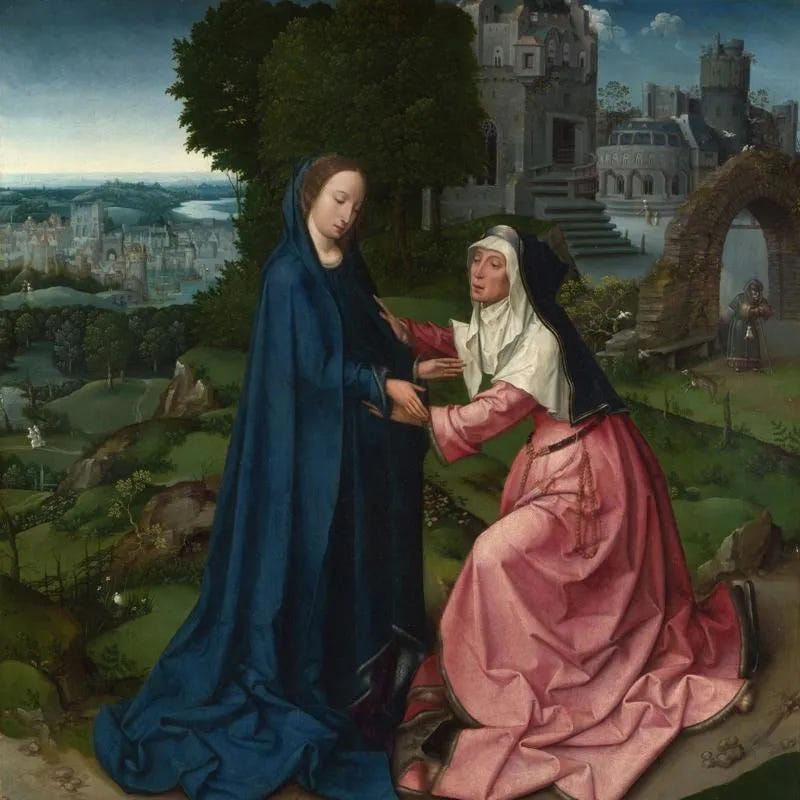
But in these final days of Advent, we meditate on another aspect of the Incarnation, which is his hidden existence in the womb of Mary prior to his birth. It is meditated in the Rosary as the second Joyful mystery, when Mary visits the mother of John the Baptist. Even though all the activity in the Gospel story takes place between the two women and the child moving in Elizabeth’s womb, the true focus of the story is the unmentioned, newly conceived child in Mary’s womb. He is the cause of the joy they experience.
Like the birth of a child, it is also a profound experience when the mother feels the child move in her womb the first time. She is carrying another life in her, and the story of the Visitation powerfully reminds us that human life begins before birth, at the moment of conception. The Incarnation did not take place at the Nativity, though it was manifested at the Nativity; it took place at the Annunciation.
In the Visitation, two unborn infants – one newly conceived and the other six months – interact with each other. Elizabeth’s child does not simply move or kick, he “leaps within her womb” (Lk 1:41), causing Elizabeth to cry out loudly (1:42). It is not a cry of pain, but an exclamation of joy.
This is the biblical image of Christmas joy: an interior movement of the spirit which results from the life of God in the soul, so “violent” that it cannot be contained but must be expressed, exclaimed. In order to born in the world today, Christ must first be conceived in our hearts. Before he can be manifested to others, the life of God must be carried within and felt viscerally.