Needle Eye
28th Sunday in Ordinary Time (B)

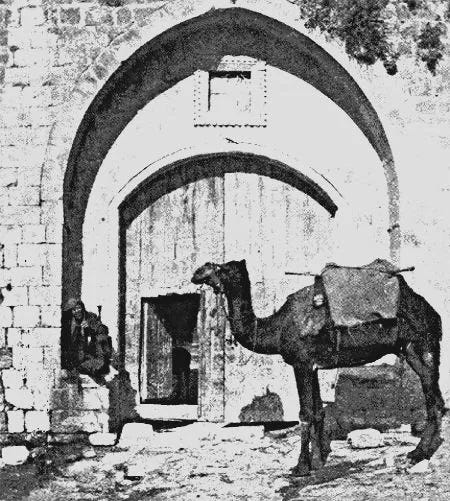
The rich young man asks Jesus what it will take to enter eternal life (Mk 10:17). Jesus’ answer is two-fold.
First, we must keep the commandments (Mk 10:19). Doing this will keep us out of hell. In order to go to heaven, we must die in the state of grace, free of mortal sin (which is a serious and deliberate violation of the Ten Commandments).
Second, we must be free of all earthly attachments, beginning with material riches (Mk 10:21). Doing this will free us from “Purgatory,” and finally allow us entry into heaven. Purgatory is the final purification of all imperfection, particularly the capital sins such as pride and greed that are rooted deeply in the soul.
Though the man had kept the commandments faithfully from his youth, it is the capital sins that proved to be the stumbling block, his “impossible” challenge. Yet Jesus makes these the main priority for his disciples, and assures us that God will see it through: “For man it is impossible, but not for God. All things are possible for God” (Mk 10:27). Peter and the other apostles demonstrate that even in this life, Christians are called to leave behind worldly things. The practice of religious life, through which men and women vow themselves to poverty, chastity, and obedience, is a response to the teachings of this Gospel.
Jesus uses the image of a camel passing through the needle eye to illustrate “what it takes” to enter the Kingdom of God. The Needle Eye refers to a very small gate in the city wall, used for defensive purposes when a city is under threat of siege and the main gates have been sealed shut. It is actually possible to get a camel through a needle eye, but it is no small task.
Camels are pack animals, and they must first be completely stripped of their luggage in order to get through the gate. This is what Jesus means by selling what we have and giving to the poor. Living in the material world we become natural hoarders, overloaded with so many goods and supplies that serve no purpose except to weigh us down and hold us back. Being stripped of goods causes worldly insecurity and anxiety, but to a man of faith it brings freedom and joy.
Secondly, in order to get the camel through the small opening, it must be brought to its knees, with its head bowed to the ground, the model of humility. We do not enter heaven with pride and arrogance, but only after being fully crushed and humbled.
Finally, we learn that the camel cannot get through the gate by its own effort, it must be pulled and shoved, cajoled and whipped. This is similar to the Church praying for the dead, since the souls in purgatory cannot help themselves. We do not come to heaven by our efforts but only by God’s grace. Yet not without our cooperation and acceptance of the trials, scrapes, and bruises it will require.
Ideally, “Purgatory” already takes place before we die. By God’s wisdom, the process of growing old already brings with it the systematic detachment from things of this world, as one by one we have to give up mother and father, houses, land, and even the strength of the body.
Death, and the sufferings that lead to death, will finally strip us of this world’s goods, but if that is not voluntary, a purgation from attachment still awaits beyond death. Jesus would have us ready to leave this world completely free and at peace, in order to fly directly to the Father’s bosom.