Original Sin
10th Sunday in Ordinary Time (B)

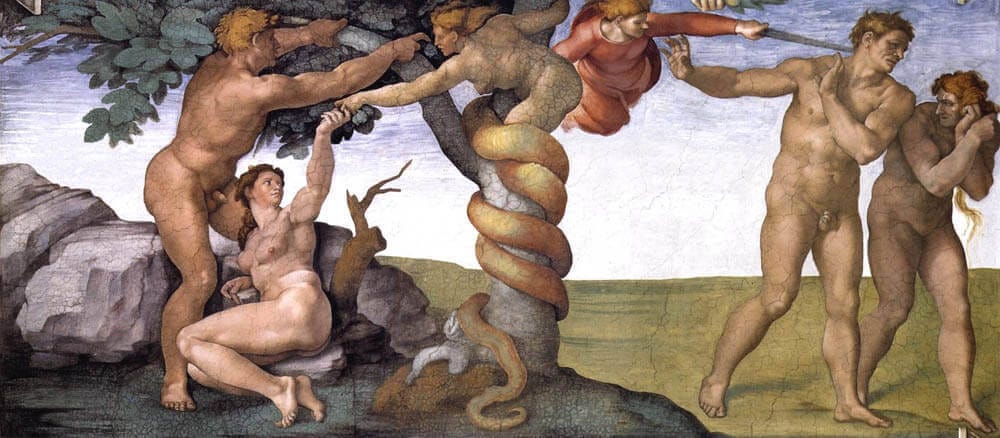
The opening chapters of Genesis are among the most important verses of the Bible, because they give the foundational revelation upon which the whole story of salvation is based. Heavily symbolic, each detail is significant.
“The man, Adam, had eaten of the tree” (Gn 3:9). In the garden of paradise where God placed man, there were two special trees: the Tree of Life, and the Tree of Knowledge of Good and Evil (Gn 2:9). While man could partake of the fruits of all the other trees, these two required a special respect and reverence, and were not for eating, particularly the Tree of Knowledge of Good and Evil (Gn 2:16-17, 3:22-23). These two trees represent important blessings in creation, coming from God for the benefit of the world He had made, and while they are “in” nature, they are higher than nature.
The Tree of Life represents the life-principle, the power of God to cause life. Nature does not have the power to bring forth life by itself: life does not result from any physical or chemical process or electromagnetic process; it doesn’t simply “happen.” Life is a special power depending upon God, and specifically established in nature as represented by this tree. As such, “life” is to be revered and respected as sacred. All subsequent morality in the Bible will emphasize the sanctity of life and the proper stewardship of life, especially human life (cf. for instance, Gn 9:4-6).
In Eden, Adam and Eve were originally blessed with abundant life and fecundity, and were commanded to be fruitful and multiply. Their proximity to the Tree of Life meant they would not taste death, nor would they experience illness. Death and the weakness of the body was a consequence of the fall (Gn 3:22-23). The tree of life still exists in the world (things still live), but now in our fallen condition we are blocked from its full benefits (Gn 3:24). Try as he might, man’s ongoing quest for immortality is futile and arrogant.
The Tree of Knowledge of Good and Evil represents the blessing of rationality (intelligence and free will) which man enjoys. This too, is well-beyond the powers of nature, and comes directly from God, and in fact makes man like God (Gn 1:27). In his natural life, man enjoys the ability to know and understand the world, and freely make his choices in accord with reason.
Unlike the Tree of Life, which animates all animals and plants, the Tree of Knowledge only pertains to man who is a spiritual creature. Whereas the animals choose by instinct, it is man’s dignity to be consciously responsible for his own choices. As with the Tree of Life, this is a great blessing that is to be respected and revered, with humble acknowledgement of God as the Lord and Creator.
When the serpent tempts man into eating its fruit (no longer receiving it as a gift on God’s terms, but usurping it on his own terms), man transgresses his domain. Instead of using reason to know and understand the truth, and make free choices in accord with its demands (as God intended), man becomes like the devil who decides for himself what is right and wrong, creating his own truth and setting up his will as something divine. Man assumes the divine power as his own, becoming his own god.
The consequences of this act are immediate and devastating. Man loses his humility, and the world itself responds to his prideful usurpation. Man is not God, and creation does not obey him, but becomes hostile to him instead. Harmony with nature is deeply injured by the fall. Likewise, Adam’s self-assertion also injures his relationships with others: Adam immediately turns on his wife Eve, blaming her (and God) for his sin: “The woman whom you put here with me made me do it” (cf. Gn 3:12).
Moreover, man’s natural intelligence and free will, like his life, is now weakened due to his misuse of the gift. With regard to intelligence, man now experiences confusion and ignorance, doubt and error. Learning requires much effort. His will too, is severely weakened and subject to every whim and desire. Man is enslaved to his own passions, to sin, and to the lordship of that serpent who can now manipulate him virtually at will.
Far from rising to the level of God, man loses the very graces which elevated him above the limitations of nature and now sinks into the desires of the flesh. Far from enjoying the dominion which God entrusted him over the natural world, he is now a slave trapped in his own limitations. The devil is now his lord, and his kingdom is one of darkness.
This condition of “original sin” is poignantly depicted in the Bible by Adam’s nakedness, representing his shame and guilt. God is not changed in any way by man’s sin, but man’s relationship with God is drastically changed: he hides from God, fleeing His face: “ I was afraid, because I was naked, so I hid myself” (Gn 3:10). Sin cuts us off from God, by our own act. We lose friendship, we cannot face Him. The exaltation of our will over God has made us self-conscious in a way we were not when we were humble: “Who told you that you were naked?” (Gn 3:11).
This nakedness has to do with knowledge, partaking of that which we were not meant to partake, and which forever alters our relationship with the world. We are born and come into the world in this condition: not simply without clothes for the body, but above all lacking the soul’s proper clothing, known as God’s “grace.” Original Sin is the loss of sanctifying grace. Though the children of Adam did not personally commit the sin at the Tree of Knowledge, they are all born into the state of deprivation by which life is weakened, and intelligence is darkened, and the will is trapped in a tendency to sin (“concupiscence”).
Only thus can we appreciate what Jesus accomplished as the New Adam. In today’s Gospel he is seen reclaiming the dominion of man’s life from the serpent. Far from being subject to demons (“By the prince of demons he drives out demons” – Mk 3:22), he is the one who enters that strong man’s house and binds him (Mk 3:27).
Christ’s mission is to restore man to paradise, but an even higher paradise than before. His Cross is both the new Tree of Life, and the new Tree of Knowledge. Whereas the original trees brought a created gift from God into the world – a power of life, a power of knowledge and free will – Jesus by his death and Resurrection brings to man the very Life of God itself, and His Spirit.
Baptism and Confirmation initiate us into the new paradise where we are blessed with the fruits of Christ’s Cross: the Resurrection, and the Holy Spirit.
Baptism washes away the stain of original sin, and clothes us again with the grace that makes us whole. Dressed in the purity of the baptismal robe, we live in the presence of a merciful and loving Father, cleansed of all sin and guilt, free of Adam’s shame. Through Christ, man now possesses eternal life, such that he already conquers death.
Likewise, through Confirmation man now possesses the Knowledge, Understand, Counsel, Wisdom, and Strength of God himself, in the outpouring of the Holy Spirit, so that he can live and act as Christ himself lived, entirely free, by the Spirit of God, in total obedience to the Father.
Let us live always in this restored grace, and enjoy the fullness of life God intended.