Prostration
Epiphany (C)

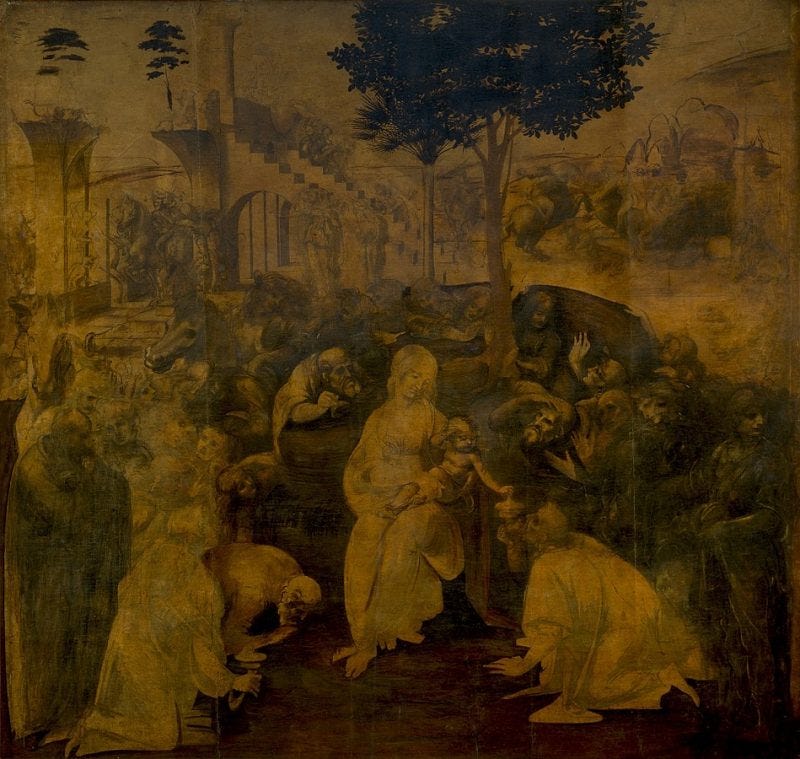
“They prostrated themselves and did him homage” (Mt 2:11).
In the liturgy of the Church and in personal devotion there are nine degrees of homage by which we express honor, worship, and respect to Jesus Christ in the posture of the body. This hierarchy culminates with the act of prostration, seen in the Gospel when the Magi bring their gifts to the Christ Child.
The first mark of respect that we show to Christ when we enter the church and begin the liturgy, is to Stand respectfully and attentively, with head erect. Traditionally, a man uncovers his head as a mark of respect, and a woman covers or veils her head. We should never slouch in church. This is the basis for all other acts of reverence and devotion.
The most common form of reverence is the bow, of which there are three types. First is the “Head Bow,” where we briefly lower the head and eyes, without moving the rest of the body. The head bow occurs whenever we say the name “Jesus” in the course of prayer.[1] After this is the “Shoulder Bow,” where we incline the head forward by bending the back and moving the shoulders. This form of reverence is most commonly used between Christians, recognizing the dignity of Christ present in each other. For instance, it is appropriate at the Sign of Peace to bow to one’s neighbor.[2] The priest and servers bow to each other in this way when interacting. Finally there is the “Profound Bow” where the head is lowered to the level of the waist. This is seen when reverencing the altar, a primary symbol of Christ in the church.[3]
In addition to bowing the head, we bend the knee: “Come, let us bow down in worship, bending the knee before the Lord our maker” (Ps 95:6). The next degree of homage is therefore the “Genuflection,” which means bending the right knee to the ground. We genuflect before the tabernacle, where Jesus is present in the Sacrament of the Eucharist. Genuflection takes place whenever we enter and leave the church, and whenever we pass in front of the tabernacle. Whereas it is appropriate to bow to a fellow Christian, the more humble act of genuflection is reserved for the Lord.[4] Bending both knees to the ground is “Kneeling.” Kneeling is always the appropriate reverence when the Blessed Sacrament is present on the altar. Whereas there is no kneeling during the first part of the Mass, there is almost continual kneeling once we reach the Eucharist prayer and consecration. “At the name of Jesus, every knee shall bend” (Phi 2:10). When the Blessed Sacrament is exposed for adoration on the altar, we “Kneel and Bow” whenever entering, leaving, or passing before the presence of the Lord.
In the highest expression of homage to God, we remember how Abraham (and Moses) “fell on his face” (Gn 17:3), and “bowed down to the earth” (Gn 18:2, Ex 34:8) in the presence of God. Especially when praying before the Blessed Sacrament, it is appropriate as an act of personal devotion, to “Kneel and Bow to the Ground,” even kissing the floor. This particular act of reverence can be found in the liturgy when the pope or a bishop opens a sacred door and crosses the threshold to enter God’s sacred presence (and analogously, when a pilgrim arrives at the holy shrine for which he set out).
Finally, there is “Prostration,” where the individual lowers himself completely to the ground, lying face down on the floor. This is prescribed in the liturgy once a year, at 3:00pm on Good Friday when the Passion service begins: the priest prostrates himself before the bare altar at the moment when Christ died on the Cross in sacrifice for our sins. It is also an important part of the Ordination Rite and Religious Consecration. This is the act of the three Magi; it expresses total self-giving and surrender, the total submission of one’s life and treasures to God.
While there are roughly nine degrees of homage and adoration that we express in the posture of the body during prayer and worship, this general outline is not exhaustive. For instance, there are other physical acts such as kissing,[5] veiling, and removal of shoes[6] that are also prescribed in certain instances.
Moreover, depending on circumstances or special occasions, the act of homage can be enhanced or diminished. For instance, whereas the normal reverence during the Creed is to bow the head[7] during the words “by the Holy Spirit was incarnate of the Virgin Mary, and became man,” during the Christmas Mass we Kneel. Or, whereas it is the norm to genuflect when passing the tabernacle, if one has knee problems it is appropriate to make a profound bow instead.
Because these acts homage are always deeply personal in addition to being liturgically prescribed, the Church has always allowed a certain leeway if someone feels spiritually moved to show a higher degree of homage than the norm prescribed, particularly when this has been a custom or tradition. Thus even though the current norm of reverence is to receive Holy Communion while standing, the Church has specifically affirmed the right of the individual to kneel down if he chooses. This must never be denied.
All adoration requires humility and submission. God must be praised and glorified – He must increase – while we must diminish. When we physically humble ourselves by lowering our body and head even to the ground, we powerfully counteract the spiritual pride that infects the soul.
Prostration is humbling, but also joyful and freeing. It liberates us to be fully human before God, and is the precondition for giving our gifts to Him: “They prostrated themselves and did him homage, then they opened their treasures” (Mt 2:11).
[1] Additionally, we can bow the head in honor of “Mary” and the saint of the day.
[2] This would be a more fitting and reverent liturgical gesture than “shaking hands.”
[3] In churches where the tabernacle is not behind the altar, this is the appropriate reverence when the priest enters the sanctuary.
[4] And on Good Friday, for his Cross.
[5] We kiss the altar, the book of Gospels, the bishop’s ring, the anointed hands of the priest, the priestly vestments, and our neighbor during the sign of peace. We also kiss relics and other devotional objects.
[6] Prescribed for the Veneration of the Cross on Good Friday
[7] Profound Bow