Purgatory
All Souls Day

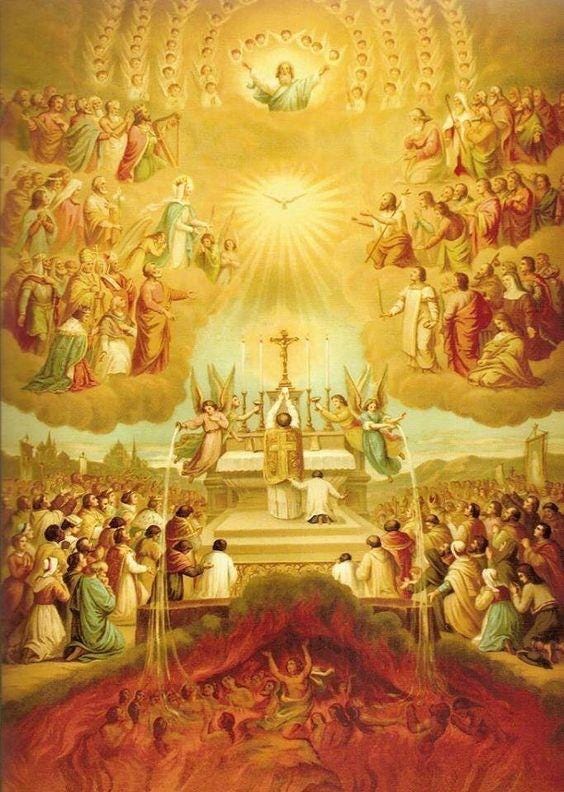
Fire is an important biblical image for the next life, and not just for hell. It works as well for heaven: in the height of heaven is a most intense fire (Ez 1:13); the face of the Son of Man will be like the sun shining in full strength (Rv 1:16); and the righteous will “shine like the sun” in the kingdom of their Father (Mt 13:43). God is a devouring fire (Dt 4:24, Hb 12:29).
This vision of Heaven as an infinite fiery sun is helpful for understanding what Purgatory is. Purgatory should not be thought of so much as a “third” place after death, somewhere between heaven and hell. We need to be clear, that after death there is only a two-fold judgment: yes or no, heaven or hell. Purgatory falls within the judgment of “heaven,” and purgatory cannot be understood apart from what heaven is.
Purgatory can be described the “place” you go to “before” heaven for a certain amount of “time,” depending on what sins and temporal punishments you still have to atone for. But Purgatory is not actually a third “place” somewhere between heaven and hell; Purgatory has to do with Heaven. More helpful is a relational description of Purgatory as the “process” of final purification before coming into Heaven. It is the “gate” or “threshold” that must be passed in order to be face to face with God in the ecstatic joy of heaven. Purgatory is the final and intense completion of the journey of holiness by which all sin and darkness are definitively burned away in the soul.
When someone walks into the bright sunlight from a darkened room, the eyes hurt and cannot see until they become acclimatized to the greater degree of luminescence outside. Likewise, when the soul leaves the veiled darkness of this sinful earthly existence and comes nakedly into the infinite glory of God, the process will be intensely painful. “Nothing impure can enter Heaven” (Rv 21:27). Even the least sin, even the least unpaid debt, even the least moral imperfection, even the least memory of regret, will be a source of unimaginable personal pain in the presence of God’s infinite being, Who is totally pure.
“God is a consuming fire” (Dt 4:24, Hb 12:29). Already in this life, God sits like a refiner of gold or silver, purifying His people of their impurities (Mal 3:2-3, Sir 2:5, Wis 3:6). To come to God is to be brought to this Fire; it is to experience one’s sinfulness and imperfection as a fallen creature, but also to experience that corruption being burned away. Therefore, even though there is pain, there is also joy. It is not the same kind of pain as hell, where there is only torment and despair.
This process of purification continues throughout our life, and to the degree we avail ourselves of the graces given to us in this world, we will be prepared at our death to pass without any difficulty to God. To the degree we fail to take advantage of the opportunities afforded us for holiness, that passage to God will not be without difficulty: “Settle with your opponent on the way to court… Otherwise you will be put into prison until you have paid the last penny” (Mt 5:25-26). We cannot be happy with God if we still have “unpaid debt,” if there is still “regret,” if there is still “unfinished business,” if there is still any tie whatsoever to our sinful earthly life and the way of the flesh. Heaven is freedom: freedom from the past, freedom from sin, freedom from guilt, total freedom to be and to love, and to be loved.
Though the word “Purgatory” is never used in the Bible, St. Paul teaches this doctrine very clearly in 1 Corinthians Chapter 3. He speaks about how a minister of the Gospel spends his years on earth building the Kingdom of God, yet only on the day of judgment will the true value of his lifework be judged.[1] If we worked well, we will be rewarded; if not, we will be cast out.
But even if our work was good – and this is the key – whatever was imperfect will still be burned away. St. Paul says that our life-work on judgment day will be “tested by fire” (1 Cor 3:13). He notes that we will be saved, but only by passing through the trial of fire (1 Cor 3:15). Whatever was “wood, hay, or straw” (imperfect work that has no lasting value; i.e., wasted time and graces) will be burned away. Only gold (perfect goodness and holiness) will pass safely through the test of fire. Gold and silver have nothing to fear from fire, fire only renders them purer. This is the clearest scriptural reference to Purgatory.
Heaven, Hell, and Purgatory all make use of fire as their image, but in each case the fire achieves something different. Heaven is fire because of the way the soul is filled intensely with Gods’ glory, but it is not a fire that harms. Purgatory is fire because of the way the soul is purged of unworthiness and imperfections. And Hell is fire because of the way the soul suffers painful torment. In all cases the Fire is God Himself, God who is Love.
If death is like falling asleep, heaven is an ecstatic dream of delight and peace, while hell is the ultimate terrifying nightmare. Purgatory, on the other hand, is a tossing and turning, a sleep of discomfort without rest. In this life, after an unfulfilled day filled with anxieties, one will toss and turn in sleep until the unfinished emotional tasks are completed. Likewise, after death, those souls whose lives were lived imperfectly will have unfinished spiritual business to complete before they can enter into God’s rest.
For this reason, we always pray that the souls of the departed may “rest in peace.” Since the earliest days of the Church, Christians have prayed for the dead that they may be freed of any venial sins still in their souls, and we personally take up works of mercy to “pay” any unpaid debts still “owed” by the faithful departed. This continues a practice that existed among the Jews before Christ (2 Mac 12:46), and which Jesus himself acknowledged (Mt 12:32 – some sins can be forgiven “in the world to come”).
Whereas the departed soul no longer has opportunity to merit grace or make reparation for sin, in the mystery of charity others can take up the debts of their loved ones. With Christ and through Christ, all are involved in the work of redemption. This is the “Communion of Saints.” Through our own prayers and good works, and participation in Holy Masses where we offer our intentions in union with the sacrifice of Christ, we are indeed able to benefit others. And this is especially true for the holy souls in Purgatory, the faithful departed whose holiness is still being completed. As the sacred scripture teaches, “it is a holy and wholesome thought to pray for the dead, that they may be loosed from sins” (2 Mac 12:46).
Eternal Rest grant unto them O Lord,
and let perpetual light shine upon them.
May they rest in peace. Amen.
May the souls of all the faithful departed,
through the Mercy of God,
Rest in peace. Amen.
[1] Jesus expressed this same idea in the parable of the talents (Mt 25:14-30).