Redemptive Offering
Feast of the Presentation

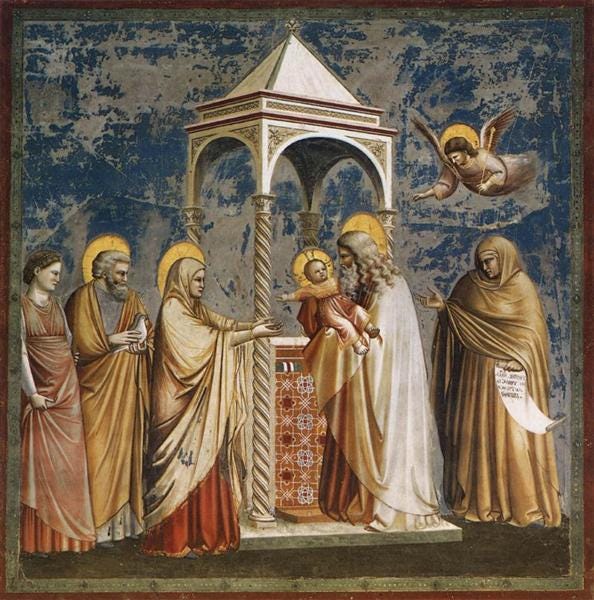
Mary and Joseph observed the Law of Moses, which required circumcision and naming of the baby on the 8th day of birth, and his presentation in the temple on the 40th day. This “presentation” is a sacrifice, by which the life of the child is offered to God. It is the reason for going to the temple, since that is the only place there is an altar to God. As with all sacrifices of the Old Law, animals are substituted, in this case two doves. The Law reminds parents that their children belong to God, and the firstborn son particularly.
Jesus fulfills the symbolism of this law, because he is not only the firstborn son of Joseph and Mary, but the firstborn son of Israel, and indeed the only begotten Son of God. He is the Messiah.
God inspires the prophets Simeon and Anna proclaim the uniqueness of his presentation, and reveal more fully to his parents the purpose of his life. Jesus will be a light to the world, a sign of contradiction, and a judgment. Ominously, he tells Mary that her heart will be pierced by a sword. Already at his infancy, Jesus’ life is overshadowed by the Cross. Jesus will be the redemptive sacrifice that takes away sin, and replaces all sacrifices of the Old Law.
Simeon’s prophecy shows the role of Mary as “co-redemptrix.” When Jesus’ side was pierced at the crucifixion he did not feel it because he was already dead. It was Mary who felt the pain of that wound, sharing fully in his sacrifice. What culminated on the cross began at the time of the Presentation.
The Law of Moses teaches that our lives belong to God, and we must offer them to God. Parents do this when they give their children to God as infants. The sacrament of Baptism now fulfills the rituals of the Old Law, including circumcision and the sacrifice of turtledoves. But the significance of the Law remains. Christian children are still brought into God’s Covenant people at infancy, and their lives are offered to God through a presentation in the temple. At Baptism parents and godparents make a solemn promise to raise the child in the Church, fulfilling the understanding the child now belongs to God and His house.
Through Baptism, children become “other Christs.” The same prophecy made about Jesus can be made for any Christian. Though the details may vary, all are called to be a a light in the world, and a sign of contradiction that exposes error and sin. All parents will experience a suffering as they participate in the sacrifice of their sons to God.
As we meditate on this “Fourth Joyful Mystery” of Christ’s life, let us ask ourselves what it means to be “given to God,” consecrated like Jesus for a divine mission. How is my life a redemptive offering, and how does the consecration of my Baptism affect the way I live today?