St. Kateri Tekakwitha
30th Sunday of Ordinary Time (C)

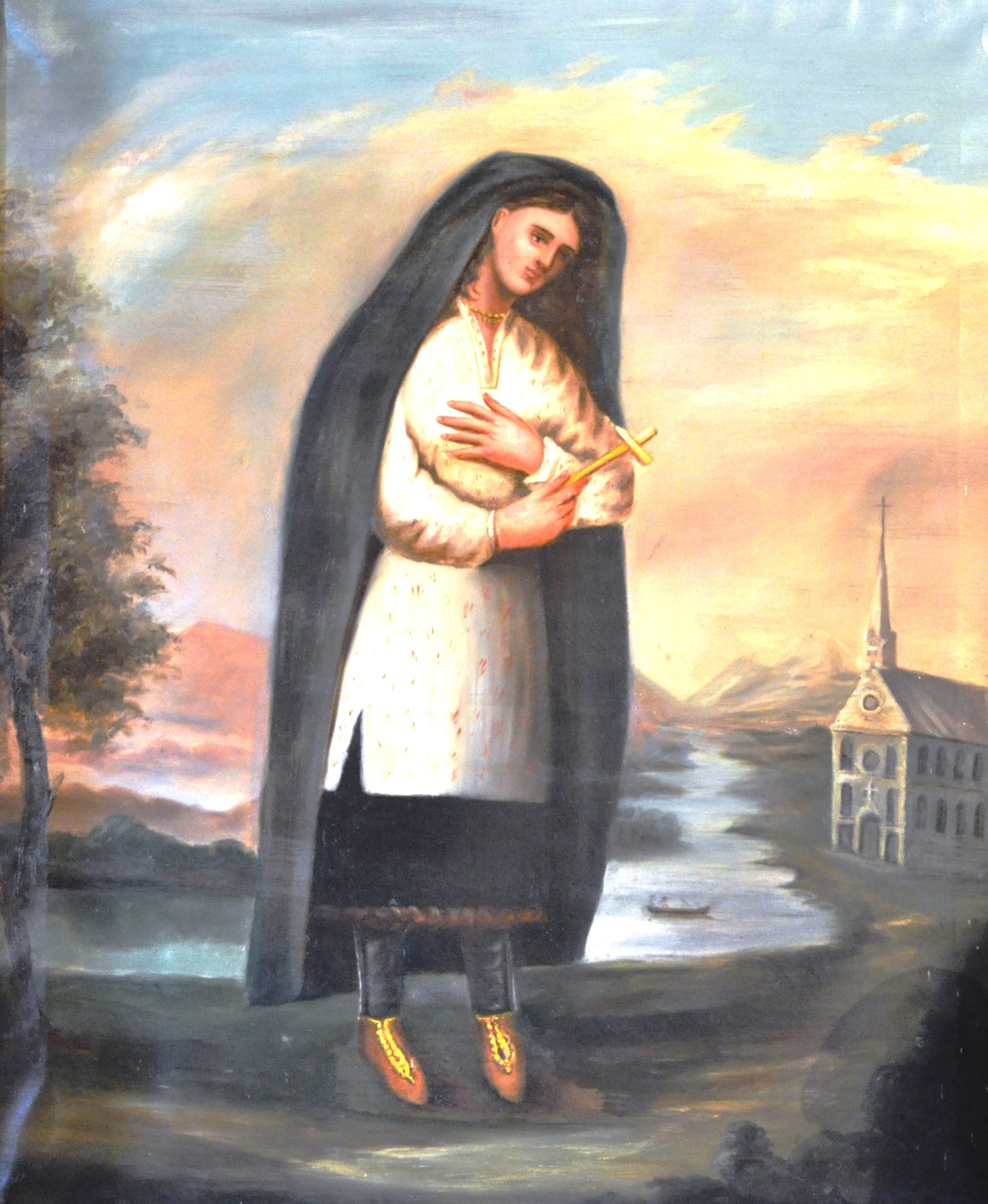
Tekakwitha (1656-1680) was born into the Mohawk Indian tribe near the Great Lakes in upstate New York. Her father was a Mohawk chief, and her mother was an Algonquin Christian woman who was kidnapped and forced into marriage. As a young girl Tekakwitha contracted smallpox, in an epidemic which killed off her entire family and left her face badly scarred. At age 19 she followed in her mother’s footsteps and became Christian, baptized with the new name “Kateri,” in honor of St. Catherine of Siena.
Her conversion and refusal to marry angered her relatives who insulted and mistreated her. After six months she fled her village to live in a special Christian village near Montreal established by the Jesuit missionaries. There she came under the tutelage of a woman named Anastasia, who had been a close friend of her mother. She wanted to dedicate herself completely to Christ and made a vow of virginity. She undertook harsh penances for the conversion of her family members, dedicated herself to prayer, and made many friendships with the religious women of her new village. She died at age 24 during Holy Week, 1680. Immediately, people noticed a physical change. Her face became radiant and smooth, and all the smallpox scars disappeared. Several people reported seeing her in apparitions following her death.
St. Kateri is known as the “Lily of the Mohawks.” Her story reflects that of so many native Americans who came to Christ through the preaching and labors of missionaries. When the New World was discovered by Christopher Columbus in 1492, the call went out from the Pope for missionaries to bring the Gospel to these lands. The Jesuits responded with great zeal, and became successful missionaries in North America, South America, and the Far East, especially in French and Portuguese territories. The Franciscans also responded with great zeal in Central America, in Spanish territories such as Texas.
The Jesuits pioneered a missionary model that became widespread. The priests would learn the native languages and live among the Indians, and set up protected villages surrounded by agricultural fields, located near a colonial outpost of soldiers. These villages had a central church, surrounded by workshops, schools, and homes. Restored examples of these can be seen today in Goliad and San Antonio. San Antonio had five of these mission villages, four of which were relocated there from foundations that began in East Texas. It was in such a village that Kateri was able to live after her baptism with fellow Christians, in safety and freedom.
The Jesuit missionaries in North America would regularly reach out to tribes in the region, seeking to make contact, engage in trade, and establish relationships. The work was difficult and slow, there was a great deal of mistrust, and tribal animosities complicated the work. Life was brutally harsh, and survival often meant violent and savage warfare, kidnappings, and torture of captured prisoners. When she was 13, Tekakwitha’s village, which was at that time allied with the French, was attacked by neighboring Mohawk warriors, who were finally defeated and then captured after several days. She witnessed seventeen captured prisoners brutally tortured for three days before being executed. A Jesuit priest assigned to her village risked his life to intervene for them, and though he was unsuccessful in stopping the torture, he did succeed in baptizing the captives before they died.
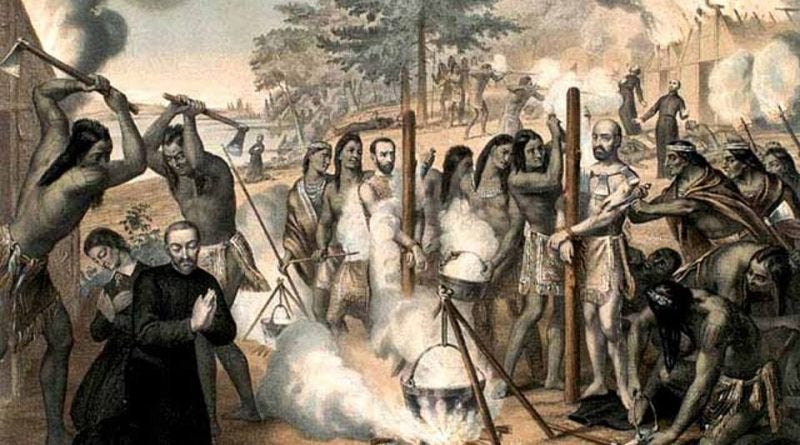
St. Kateri’s story is therefore not complete without the stories of the dedicated missionaries, many of whom gave their lives as martyrs to bring the Gospel to a land overshadowed by darkness, violence, and cruelty. The blood of martyrs is the seed of Christians. Eight of the French Jesuit missionaries, known as the “North American Martyrs,” are canonized. They were all martyred in the 1640s, during the time of her mother’s conversion. All of them suffered the kind of cruel torture Kateri witnessed in her own village.
“I am being poured out like a libation” (2 Tm 4:6). SS. Jean de Brebeuf and Gabriel Lalemant had their skin stripped and then mockingly baptized with scalding water. St. Jean died when a burning torch was put into his mouth. His body and blood were cannibalized.
Another inspiring story is that of St. Isaac Jogues. When his band of Christians was attacked and captured by Mohawks, Fr Isaac left his hiding place to join them. He was beaten with sticks, his fingernails were torn out and his fingers gnawed down to expose the bones, his thumb was cut off. He was hung from a wooden plank, and burning coals were thrown onto his body. For several days he was tortured, and yet he continued to strengthen and comfort his fellow prisoners, preach to his captors, hear confessions, and even perform a baptism. His companion St. Rene Goupil was tomahawked after he made the sign of the cross over a baby.
For a year, Fr. Isaac Jogues manages to live in captivity, severely malnourished. A Dutch Calvinist minister finally rescued him, and he returned to France, where he became something of a religious celebrity. The Pope gave him a special dispensation to say Mass using his mutilated hand, since he could not hold the sacred host in the usual way. Despite everything, Isaac desired to return to the missions, where he was again captured in 1646, and tomahawked with another companion, St. Jean de Lalande, on October 18.
Many of the natives, such as Tekakwitha, were struck by the bold message brought by the missionaries, a promise of mercy and peace they never heard of before, in a world characterized by violence and brutal death. The priests she met did not fight with weapons, and they preached mercy even for enemy captives. What they brought was something new and completely unheard of: the dignity of man created in God’s image, the ability to be reborn to a new life of grace and holines. Had the battle gone differently when Tekakwitha’s village was attacked at age 13, she would have been captured and forced into marriage like her mother had been. It is likely that her desire to imitate her mother and become Christian began at this time, as well as her desire not to be married against her will. The priests had showed her something else unheard of in her world: the ability to remain unmarried, for Christ.
As a Christian, St. Kateri (Catherine) would spend her remaining years trying to imitate the martyrs and the words of St. Paul, by pouring out her life in prayer and penance and consecration, as a “libation” (drink offering) for God, on behalf of her people. May the saints and martyrs inspire us likewise, to offer our lives for His glory.