Sunday Mass
2nd Sunday of Easter

The Gospel reading from St. John recounts the first two general resurrection appearances of the Lord to the apostles as a group. Throughout the day on Easter Sunday Jesus appeared individually to his disciples, beginning with Mary Magdalene, but now in the evening he appears in the midst of the “church,” the gathering of the faithful. He will do the same on the following Sunday, eight days later (Jn 20:26).
After remaining in Jerusalem for an extra week following the Passover, the apostles returned to their homes in Galilee, where again the Lord continued to appear (cf. Jn 21:1). In a few weeks they came back to Jerusalem to prepare for Pentecost, where Jesus appeared for the final time in the Ascension.
Jesus is setting the pattern which the Church will follow for all time, until his second time: the faithful will gather on the first day of the week, Sunday, the day of Resurrection, and the Risen Lord will infallibly appear in their midst, to nourish, teach, and dispense mercy. In the first 40 days of the Resurrection, this appearance is entirely visible. The disciples can see him with their eyes, hear him with their ears, and touch him with their hands. These Resurrection appearances are necessary to cement their faith, remove their doubts, and seal the teachings he has imparted since they became his followers several years before. These apostles will be the foundation of the Church, and the Church is built on the Resurrection, thus they must experience that Resurrection fully.
For the rest of the faithful, “Blessed are they who have not seen, but believe” (Jn 20:29). Our faith does not depend on seeing the Risen Lord visibly, but rather on their testimony, sealed by the outpouring of the Holy Spirit at Pentecost.
And thus it is, that 2000 years later, the disciples of the Lord continue to gather in his name each Sunday, and without fail he appears in their midst, and the Church continues to be built up and live in the power of the Resurrection, without any doubt.
St. John was fully aware of the importance of these Resurrection appearances for the work he and the other apostles would undertake to establish the Church. He is aware of the different way in which the apostles saw and believed in the Resurrection, and the way in which future disciples – who never knew Christ in the flesh on earth – would come to faith in him. This is why he writes his Gospel account of Jesus Christ in the way he did, “that you may come to believe that Jesus is the Christ, the Son of God, and that through this belief you may have life in his name” (Jn 20:31).
St. John was fully aware, in the years following the Resurrection, that the Lord was present every time the Church gathered to celebrate the Eucharist, in exactly the way he describes in John 20, and all his writings help Christians come to see this.
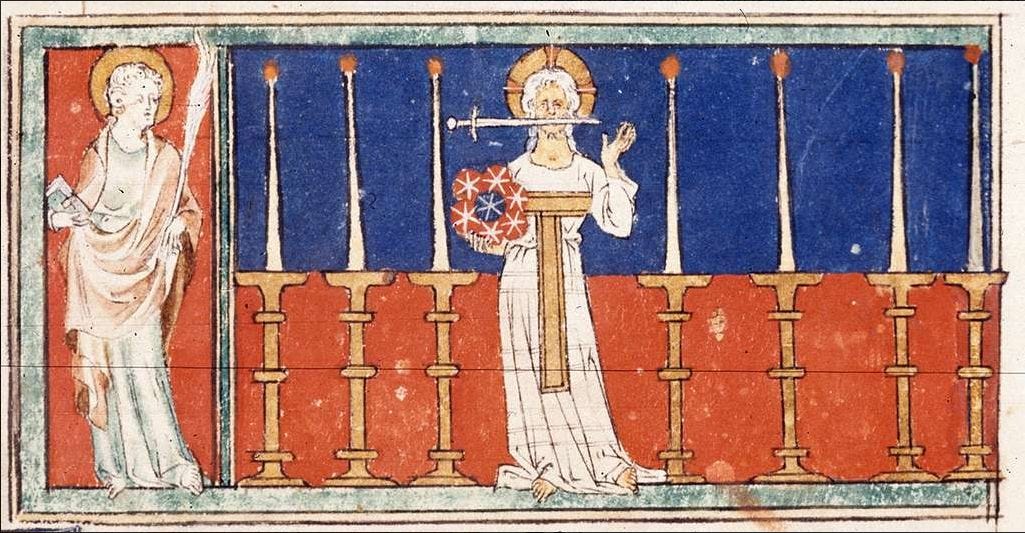
This is especially true, for instance, in the Book of Revelation, which he wrote sometime in the 60s, when the Church was undergoing severe persecution and tribulation under the hellish beast Nero. In today’s second reading, St. John describes how he was exiled from his beloved Ephesus communities on the island of Patmos on account of preaching the faith (Rv 1:9). The entire vision of this book is situated in the context of the Lord’s Day, Sunday (Rv 1:10), when the Lord first appeared and always appears to his Church. On this Sunday the vision of the Lord calls to mind the eternal glory and power of the Resurrection, because John sees Jesus in his Transfiguration glory (Rv 1:14-16).
The key to understanding all the mysterious images and symbols in the Book of Revelation is the Sunday Eucharist. St. John wishes to “unveil” the Mass, to show us the invisible reality behind the visible actions of the sacred Memorial. Taking her cue from this great book of “Revelation,” the Church has always sought to incorporate the very symbols John mentions into her sacred celebration.
Thus we gather here today, Sunday, and like John our gathering is signaled by the great “trumpet” of the opening hymn, followed by the voice of God in the readings, and the 7 lampstands: six of which are on the high altar, the seventh being the Paschal Candle in front. Standing in the midst of them we see the priest, vested in “ankle-length white robe, a golden stole across his chest” (Rv 1:13). The priest acts in the person of Christ; or rather, through the sacramental Holy Orders of the priest Christ acts personally in the midst of his disciples, taking the bread and wine, and consecrating it as his Body and Blood of the Last Supper.
In the Sunday Mass, we try to keep before our eyes and ears the things St. John saw and heard on the island of Patmos, above all, the recognition of the Risen Lord in our midst, in times of distress and trial.
During the forty days of this Easter Season, let us deepen our experience of these mysteries, let us grow in an unveiled vision of the Resurrection, and despite not seeing with these eyes, let us believe, seeing on a deeper level.