Temptation
1st Sunday of Lent (A)

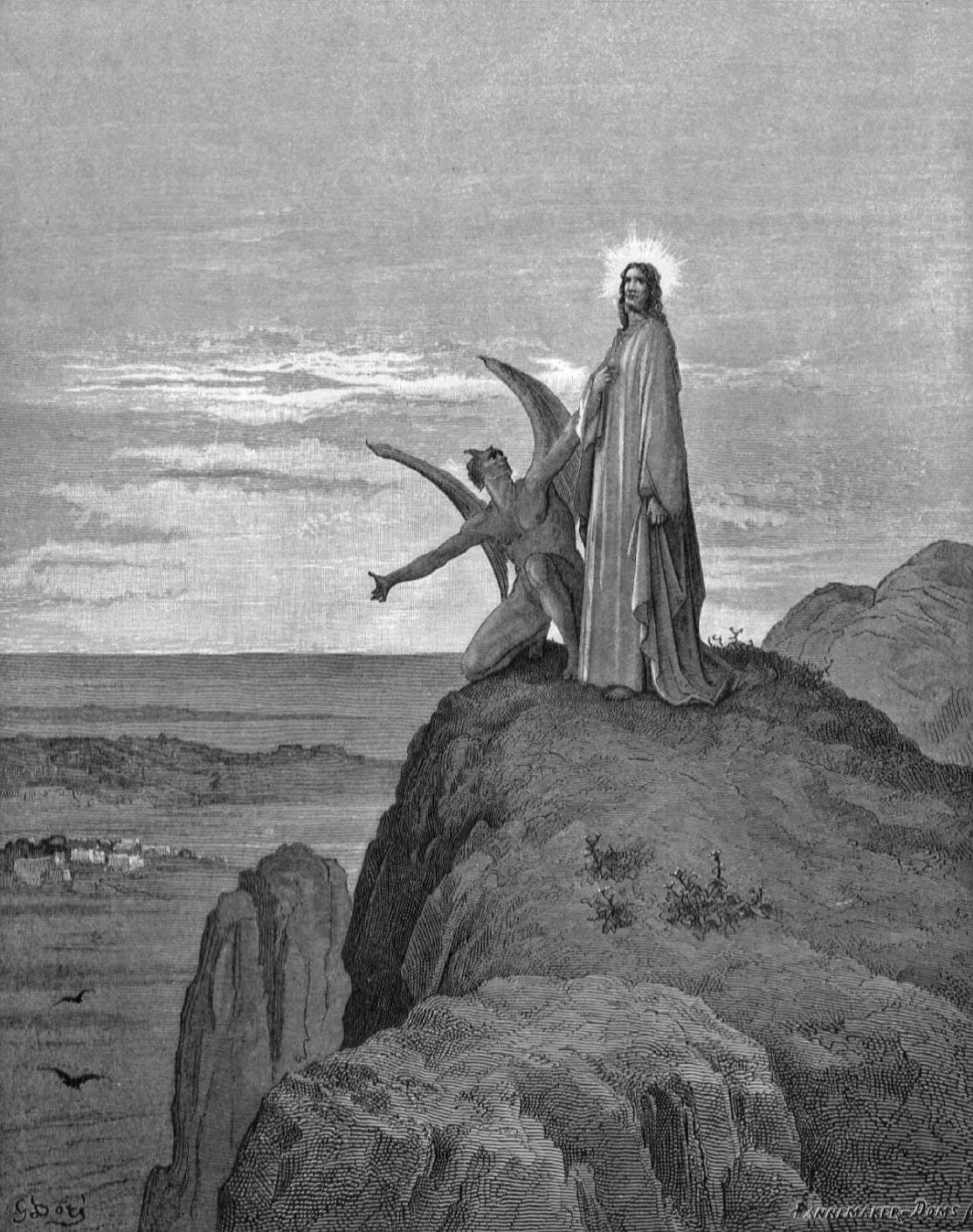
For 40 days Jesus goes into the desert in order to do spiritual battle. He experiences the limitations of human nature, and faces temptation just like Adam did in the Garden of Eden. Unlike Adam, he is victorious, and this gives us hope as we follow him into the spiritual desert of Lent.
When we give up something important during Lent, this fasting allows us to understand better the weakness of our human nature, and the importance of grace. Temptation is strong, and sin is not easy to overcome.
The first reading illustrates how Adam and Eve were tempted. “The woman saw that the tree was good for food, pleasing to the eyes, and desirable for gaining wisdom” (Gn 3:6). Good, pleasing, desirable. “Sin” is always something we perceive as good, something pleasurable or satisfying, and something we desire or want due to an attraction. We do not directly choose evil when we sin, we choose a good. A sinful act is not entirely bad; in fact is it very often “mostly good.” Because of this, it can be easy to justify, and hard to avoid.
“She also gave some [of the fruit] to her husband, who was with her, and he ate it” (Gn 3:6). Sin is made easy by peer pressure. It is unlikely that Adam would have sinned without this action of his wife Eve. Other people are a source of temptation, particularly those who are important to us in some way.
Finally, it is the devil who brings about the temptation to sin. Notice how cunning he is when he begins to speak to Eve: “Did God really tell you…” (Gn 3:1). What kind of question is that? It is manipulative. It subtly introduces doubt, and mistrust. The devil wishes to drive a wedge between man and God, so that man questions and mistrusts his Creator.
If this is temptation, what then is sin? If food is not only good, pleasing, and desirable but also necessary, how can it be sin? If my fellow man is good and necessary, what is lacking in the human acts that cause them to be sin?
What is lacking is the love and obedience due to God, our highest good. Jesus illustrates this by the way he faces and overcomes temptation. After fasting for forty days he is very hungry. Food is good, desirable, and even necessary for his body, and thus the devil tempts him: “what is stopping you?” Jesus replies with an important Scripture passage, “Man does not live on bread alone, but on every word that comes forth from the mouth of God” (Dt 8:3). Jesus does not deny that bread is good or necessary, but he proclaims it is not the highest good. God is the greatest good, and hunger for God must therefore supersede even the physical hunger of a forty day fast.
Why do we fast during Lent? To show that God is the highest good. As we struggle with a particular area of sin our lives, and try to give it up, we must face and come to terms with the “good” it represents for us, and “desire” it satisfies. We must learn, even painfully, that we have somehow substituted that good for God, camouflaging in the flesh the deeper spiritual desire for Him who alone can satisfy the heart.
When we undertake our Lenten commitments, in addition to making personal commitments we also do certain things together, such as common fasting and abstinence from meat on Fridays. As a parish we walk the Stations of the Cross together each Friday. It is important for each household to undertake certain common practices, in addition to each member’s private commitments. This is very helpful, because it provides support and reinforcement in times of temptation. “Peer pressure” can work both ways: as a source of temptation to sin, or as a source of encouragement to holiness.
Our Lenten commitments should affect our relationships. In order to avoid sin, we may have to avoid certain people or situations, and spend more time with other people in new situations. We ourselves must become a positive example through corporal and spiritual almsgiving, helping others in their struggle.
The third aspect of temptation is the devil, and here again Jesus illustrates the proper way to overcome his cunning. Any time the devil speaks, Jesus responds with Scripture that actually addresses man, not the devil! And each time the Scripture directs man to his relationship with God as his highest good and end.
What would the Genesis story have been like if Eve, instead of responding to the serpent’s cunning question the way she did, immediately responded with the Scripture verse used by Jesus: “The Lord, your God, shall you worship and him alone shall you serve” (Dt 6:13)? She would not have sinned.
A good practice would be to memorize one of these verses used by Jesus in the Gospel, and pray it immediately when we encounter the unavoidable moments of temptation.
The goal of Lent, then, is not simply to overcome sin, or conquer the devil. The goal of Lent is rediscover, purify, and preserve communion with God. The things we give up are not necessarily all bad, but they are not the greatest and most necessary good. The people in our lives are not all evil, but on the other hand these relationships need purification and correct ordering by the love of God. The voice of temptation may sound reasonable and convincing, but there can be no room for doubt or disobedience toward our Heavenly Father.