The Banquet
22nd Sunday in Ordinary Time (C)

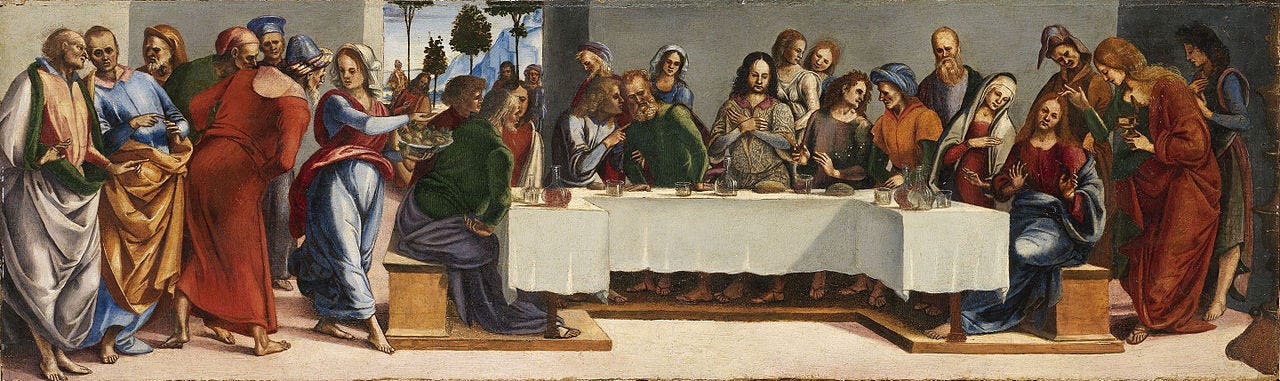
The Banquet was a very important part of social life in the time of Jesus. The banquet room was the most lavish room in the house, with expensive carpets and cushions. There are no chairs; the table is low to the ground, because guests “recline” to eat (cf. Lk 14:8), using cushions to prop themselves up. It is a very intimate occasion, shared only with family and friends, and those with whom one wants a close relationship. Sharing a banquet forms a bond, strengthens an alliance, establishes a covenant, celebrates a marriage.
Inviting someone to a banquet is the greatest honor one can give; because in a banquet, the host’s honor is at stake. He manifests himself in his full generosity and benevolence. He will slaughter the fattest calf, and spare no expense.
In its ideal, a banquet is form of hospitality that seeks nothing in return but friendship, love, and communion. Practically speaking, however, banquets devolved into tools of social and political maneuvering, as is evident in today’s Gospel, where the leading Pharisee invites Jesus to a banquet in order to make him somehow beholden to him afterward: “everyone observed him carefully” (Lk 14:1).
Jesus uses the occasion to reestablish the correct meaning of the Banquet, both on the part of the invited guest, who must be humble at the honor accorded him by a superior (“seek the lowest place”), and on the part of the host, who must seek nothing in return for his generosity and hospitality (“invite the poor and the lame, who cannot repay you”).
Without a correct understanding of the Banquet, we cannot fully understand Jesus’ teachings and actions in establishing the Kingdom of God. He regularly compares it to a wedding banquet. It is his favorite image of what heaven is. The culmination of his mission is the banquet of the Last Supper, which becomes the central ritual of the Church which he establishes. The Mass is the Banquet of the Lord, an earthly participation in the heavenly promise.
The Lord, who is richest of all lords, is an unsparing host, offering his greatest riches and the finest hospitality by giving Himself to the guest, Body and Blood, Soul and Divinity. He honors the invited guest to the point of being the servant who will wash his feet. It is his honor to die for the guest, that he might live and enjoy the banquet of Love which the Godhead shares in the communion of the Trinity. It is into this intimate communion of Father, Son, and Holy Spirit that the guest is invited.
For our part, we must approach the Mass with the highest thanksgiving (eucharistia) we can bring, with greatest gratitude and humility. Though we are unworthy in every way, this is negated by the invitation of the host. Though we are poor, crippled, lame, and blind, with nothing to offer, allowing the Lord to host us in His divine banquet is itself the gift He seeks most.
At every Mass we are reminded of the Banquet, when the priest presents the host before Communion: “Behold, the Lamb of God; behold him who takes away the sins of the world. Blessed are those called to the [wedding] supper of the Lamb.” One of the most important prayers we say is the response of humility that follows: “Lord, I am not worthy that you should enter under my roof, but only say the word, and my soul shall be healed.”
Let us approach the Banquet of the Lord in the spirit of this humility, and rejoice in the great honor God bestows on His creature.