The Empty Tomb
Easter Sunday

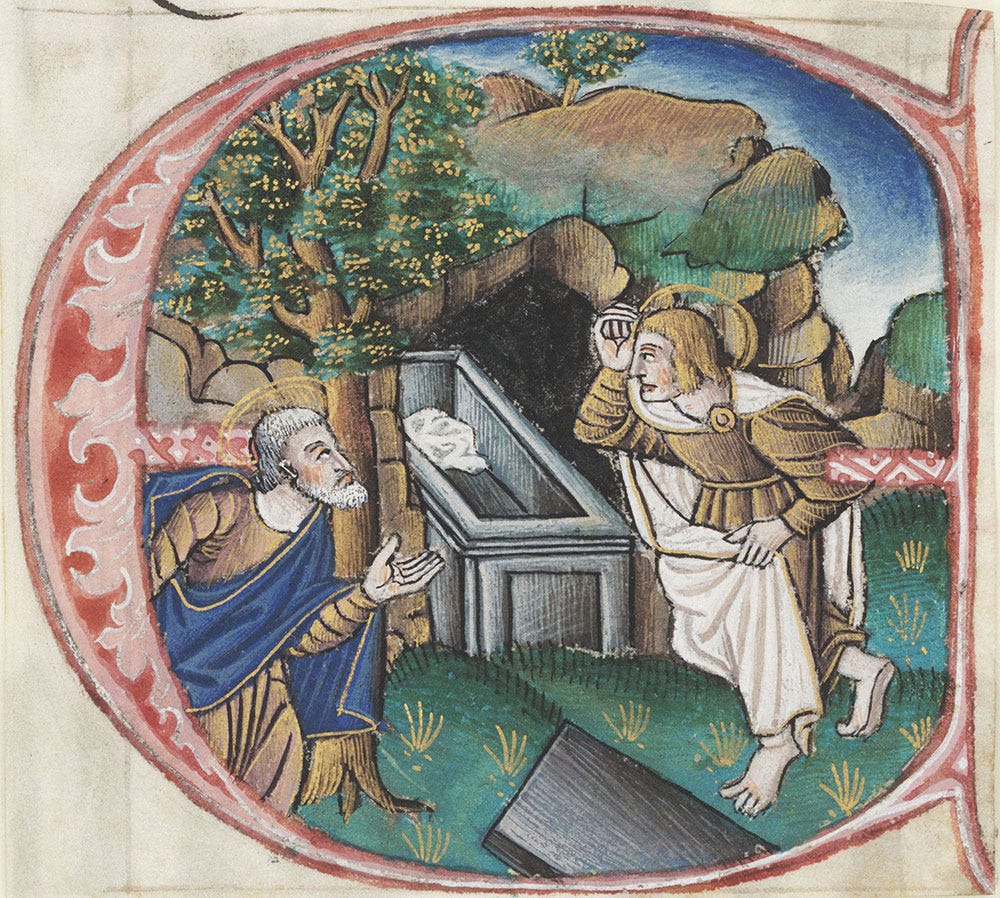
It’s hard to imagine what the disciples of Jesus were experiencing on the day of his crucifixion, and the Sabbath of his burial. Not only sorrow of grief because of their deep personal love for him, but extreme confusion at his defeat. No one intervened to save him, God did not stop it. The one effort to fight for him during his arrest was stopped by Jesus himself: “put away your sword.”
And at each subsequent step of his arrest, condemnation, and punishment, there must have been utter disbelief among the disciples: how did he not extricate himself from the legalistic traps being set up by the high priest at his midnight trial – as he had done countless times when confronted by scribes and Pharisees? Why was it allowed for him to be handed over to the Romans, so hated by all Jews in Jerusalem including the leadership? Why did Pilate brutally scourge and finally condemn him when he himself had several times declared his innocence? At what point would the angels of heaven intervene so that the Kingdom of God could be established, as expected by all the crowds who hailed him into the city that Passover as “Son of David”? Knowing who he was, why did God permit Jesus to be actually crucified, taking the place of the notorious criminal Barabbas who should have been on that middle cross?
What were the disciples to make of his brutalized and impaled bloody corpse, which had to be temporarily buried without any preparation on the Sabbath eve, when only weeks before they had seen him command the corpse of Lazarus to come out of the grave? What did the disciples feel on that Saturday, when all the city around them celebrated, and Jesus was gone, dead?
What was in the hearts of those women, we set out for the tomb at the first opportunity, early on the first day of the new week, before the sun had even risen? Now they would begin the sacred task of cleaning and preparing his body for a dignified burial. Carrying death, sorrow, and confusion in their hearts, they arrived only to find the tomb opened, and the body missing. This was the final trauma, a final insult to everything they held dear about their beloved Jesus, whom they confessed to be the Lord and Messiah. Who took him? What have they done with his body?
At that moment, the empty tomb was possibly even more painful for them than the hasty burial on Good Friday. It was in panic that the women ran back to bring the apostles news of this devastating situation. Peter and John react in disbelief. They run, and John doesn’t even wait for Peter, they must see for themselves.
Our Christian faith begins at the empty tomb on Easter Sunday morning. Everything else we believe starts from the questions which that empty tomb raises, and their answer.
Who took him? Where is the body? And why would they take him? The guards posted at the cemetery saw nothing. The questions multiply, but they do not add up. John is the first of the disciples to begin to realize there is something more – much more – going on. It happens when he steps into the tomb and sees the burial shrouds. His Gospel account of the empty tomb focuses on the linen cloths. Why are they here, one folded neatly, one thrown down on slab like a used towel? The biggest question is not who took the body and why? The biggest question is: whoever took the bloody corpse, why did they not take it in the shroud which had been wrapped around his limbs? “He saw and believed” (Jn 20:8).
As the day unfolds, beginning just a few moments after they leave the tomb and Mary Magdalene stays to ask the gardener where the body is (Jn 20:14-15), Jesus appears to each of his closest disciples, revealing himself alive in the Resurrection. Not simply “back from death,” but alive in a new life that surpasses his former mortal condition. He is now “Athanatos,” deathless. And he is the deathless one because he is the divine Son of God… All Christian faith begins at the empty tomb on Easter Sunday morning. All Christian belief is put forth as the singular truth, which alone answers the enigma of the empty tomb.
The most common alternative to the Christian answer is the official narrative propagated by the media of the day: “His disciples came by night and stole him away while the guards slept” (cf. Mt 28:11-15). It remains the official narrative of the secular establishment to this day – by which the disinformation of Christianity may be dismissed, mocked, canceled, and censored when necessary – but like every cover-up it works only for the gullible and those who do not question it.
According to this narrative, Christianity is founded upon a lie. Is that what happened? After having gone through the evils of Holy Week, the disciples, in the midst of their grief and devastation and the threat of their own lives, hatched a plot to perpetrate a deliberate fraud? Hundreds of them subsequently made up stories of seeing Jesus alive, deceiving such skeptics as St. Paul?[1] These witnesses subsequently spend the remainder of their lives carrying that lie to the ends of the earth, in a unified manner, suffering brutal martyrdoms for the sake of that proclamation, and none ever recanting or exposing the “lie”? Is that what happened?
The great fourth century bishop, St. John Chrysostom, continued to ask questions of the empty tomb hundreds of years later, and he summarily demolishes this official narrative: “to those who were worthy, Jesus showed himself alive, giving them full assurance by many proofs during forty days [Acts 1:3]. … Consider their transformation: those who were fearful and hiding after the crucifixion, who shut themselves in for fear of the Jews [John 20:19], now, after seeing him risen, proclaim him boldly even to death. What could account for this change but the truth of the resurrection? … If it were a lie, would they have endured tortures, imprisonments, and death for it? No one dies for something they know to be false. Their courage, their preaching, their miracles—all these confirm that Christ is risen.” (Homily on Acts of the Apostles)
Like all the mysteries of faith, we cannot claim to fully understand or explain the Resurrection. But like those first disciples, having celebrated Holy Week we too come to the empty tomb and see what they saw. We too ponder what it means, and consider the questions it raises. Like them, we then return to read the scriptures again, to speak with other disciples who arrived before us, and to listen carefully to those who claimed to see him.
May the Lord confirm for each of the truth which is boldly proclaimed today and for 2000 years: Jesus is risen; Christ is risen indeed. Behold the place where they laid him, and see the garments he no longer needs.
[1] For I delivered to you as of first importance what I also received, that Christ died for our sins in accordance with the scriptures, that he was buried, that he was raised on the third day in accordance with the scriptures, and that he appeared to Cephas, then to the twelve. Then he appeared to more than five hundred brethren at one time, most of whom are still alive, though some have fallen asleep. Then he appeared to James, then to all the apostles. Last of all, as to one untimely born, he appeared also to me. (1 Cor 15:3-8)