The Homebound
5th Sunday in Ordinary Time (B)

There are four main groups of people in the parish. The first group is those who attend Mass regularly and are active in the life of the parish. The third group are those who are “inactive,” whose attendance and participation are minimal and sporadic.
The fourth group are those buried in the cemetery. Even though they have died, there is still a relationship with them. We remember them in the prayers and intentions of the Mass, especially on All Souls day, and we visit their graves. They too, assist us from heaven where the Lord God entrusts to the saints an intercessory role for the Church on earth. The Church exists both in heaven and on earth, and that is certainly true on the parish level.
The other, second, group is the focus of our Gospel reading today. These are the parishioners who are unable to participate in the Mass and parish life physically, due to illness or debilitation. The homebound, and those in nursing homes or hospitals, comprise this group. They are a very important segment of the parish, whose service and participation is spiritual.
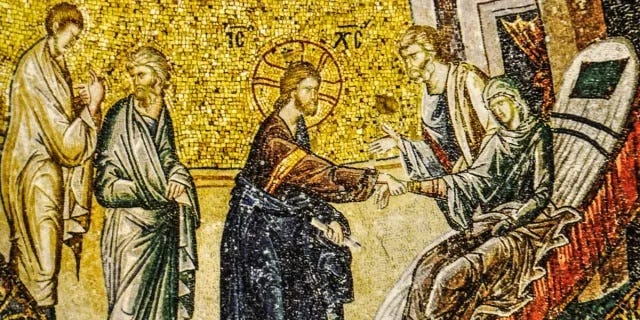
Jesus had been teaching in the synagogue of Capernaum, and when he returned to the house of Simon and Andrew they told him about Simon’s mother-in-law who was sick and could not attend. Jesus immediately went to her and grasped her by the hand. She immediately began to serve him.
Since the first century, the Church has had the practice of bringing the Eucharist to those who absent from the communal celebration.[1] It was the first reason the Blessed Sacrament was reserved beyond the celebration of Mass: it was needed for the sick. It has always been understood that the sick, even though they are physically absent, still participate spiritually, and are able to receive Holy Communion without having attended Mass. They participate through the sacrifice of Christ’s Cross in which they share by physical illness and debilitation. They “live” the Mass on a deeper level, because they are united with the suffering Christ.
The Sacrament of Anointing of the Sick is established by Christ for this purpose: to unite the sick person in their suffering to the death and resurrection of the Lord, giving their suffering a Eucharistic meaning, and to consecrate their illness as a sharing in the redemptive work of Christ. They serve the Lord. At a minimum, the head and hands must be anointed while the priest says, “...May the Lord... save you and raise you up.” This anointing of the hands recalls Jesus grasping the woman’s hand in order to heal her and “raise her up” for service.
It is important to inform the parish office of any family member or neighbor who is homebound so that they may be added to the visitation list and receive the sacraments on a regular basis. The parish priest is obligated to visit the sick personally and ensure they are able to go to confession, be anointed, and receive Holy Communion, but he is usually assisted by a team of volunteers to help him. This ministry also ensures that the dying are prepared the Last Rites in a timely way, where they can consciously renew their profession of faith and receive Holy Communion. Because it can be difficult to locate a priest in an emergency, families should not wait until the last hours of a person’s illness to call the priest; he should be called as soon as someone is no longer able to attend Mass regularly due to debilitation.
Those who are homebound continue to serve the Lord and their parish. They should cultivate a more extensive daily prayer life, and utilize the availability of televised Masses to follow along with the Church’s readings. When the priest comes to bring the Eucharist, it is opportune to set up a table with white cloth, crucifix, and candles, to serve as an altar.
Like the Church’s monks, nuns, and hermits who live a hidden contemplative life of prayer and penance, the homebound share deeply in the Church’s mission through prayer and sacrifice. Let us take to heart the example of the apostles in today’s Gospel, and bring the Lord’s healing presence to our loved ones who are ill and confined.
[1] cf. St. Justin Martyr, First Apology 67: “...there is a distribution to each, and a participation of that over which thanks have been given, and to those who are absent a portion is sent by the deacons.”