The Penitential Rite
30th Sunday of Ordinary Time (C)

In 1st Corinthians 11:27-30, St. Paul said this about receiving Holy Communion: “Whoever eats the bread or drinks the cup of the Lord in an unworthy manner will be guilty of profaning the body and blood of the Lord. Let a man examine himself, and so eat of the bread and drink of the cup. For any one who eats and drinks without discerning the body eats and drinks judgment upon himself. That is why many of you are weak and ill, and some have died.”
We are to examine ourselves carefully, in order to have a proper disposition for receiving Holy Communion. The parable of the Pharisee and Tax Collector illustrates this lesson. Jesus shows us the proper way to examine ourselves when “coming to Church.” Above all, we must approach the Lord’s table with humility, an honest awareness of our need for God’s mercy.
The Liturgy of the Eucharist teaches us to imitate the attitude of the tax collector by means of the Penitential Rite: we lower our eyes (by bowing our head). We confess our sinful thoughts, words and deeds, striking our breast in contrition: “through my fault, through my fault, through my most grievous fault.” Above all, we repeat the publican’s prayer, “Lord Have Mercy.”
This Penitential Rite is so important and ancient, that even when the Mass came to be celebrated in Latin (5th century), the Litany of Mercy remained in the original Greek: “Kyrie eleison, Christe eleison, Kyrie eleison.”
The Penitential Rite thus includes all the elements necessary for forgiveness of sins: examination of conscience, confession of sin, contrition, and absolution. The “Minor Absolution” of the Penitential Rite – “May Almighty God have mercy on us, forgive us our sins, and bring us to everlasting life” – is a true pardon of our (venial) sins.
Thus, even though like the tax collector we approach the door of God’s house as sinners, our passageway through that Door into His presence is one of purification from sin. The “gateway” to the Eucharist is the mercy of God, received with humility, and confession of sins (cf. Ja 5:16).
As the Mass continues, we invoke the mercy of God several more times, for instance in the Gloria,[1] the Eucharistic Prayer,[2] the Agnus Dei,[3] and the prayer of the Centurion.[4] At each of these moments, we may strike our breast.
When we finally approach the altar at the time of Holy Communion to receive the Lord and enter into his nuptial banquet, it is the purified and immaculate (sinless) Bride that receives her Lord (Eph 5:27).
In the early Church, the minor absolution of the Penitential Rite was all that was needed for the pardon of sins. Christians knew they were sinners, and confessed their sins (Ja 5:16), but it was unthinkable that a Christian, once converted and baptized, would commit a “mortal” sin (Hb 10:26).
All sin offends God and harms the relationship with God. But not all sin is “deadly” (Jn 5:16-17) or mortal. Mortal sins destroy the sanctifying grace of baptism and separate us from God. They also separate us from the Church, and the ability to receive Holy Communion. A mortal sin is any serious disobedience to one of God’s laws (“10 Commandments”) that is done freely and knowingly.
Reconciliation after a mortal sin requires a different process, than the Penitential Rite. It requires the distinct Sacrament of Penance. In the early Church, the Sacrament of Penance was fairly rare, and typically reserved to the bishop. When celebrated, it was public. The one who had violated his Baptism through serious sin could only approach the door of the church, and remain in the back doing penance, until the following Easter when the bishop would reconcile him (cf. 1 Cor 5:1-5).
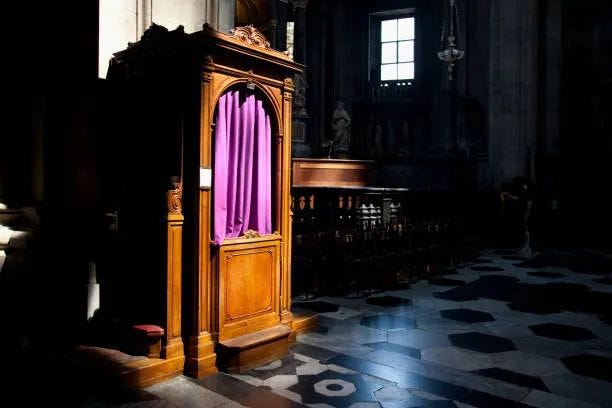
Today, in a typical Catholic church built according to the traditional style, the Confessional is appropriately located in the “back” of the church near the narthex. This follows the practice of the early church, which in turn derives from today’s Gospel, where the Tax Collector remains “at a distance” (Lk 18:13) from the altar.
As the Church spread, monasteries became the common place for Confession, Penance, and Reconciliation. Monastic priests became the typical confessors, delegated by the bishop to reconcile sinners. Today, all priests have “faculties” from their bishops to hear confessions and absolve even the most serious of sins. Only a few types of sins are still reserved to the bishop alone or the pope for absolution.[5] Today Catholics try to go to Confession regularly, even if they only have venial sins to confess, to avail themselves of other healing and spiritual graces in the Sacrament.
Through the Penitential Rite of the Mass and even more so in the Sacrament of Penance, the Church cultivates the humility and self-honesty that Christ seeks in his followers, illustrated in today’s Parable of the Pharisee and Tax Collector.
[1] “You take away the sins of the world, have mercy on us… you are seated at the right hand of the Father, have mercy on us.”
[2] “To us also, your servants, who though sinners, hope in your abundant mercies…”
[3] “Lamb of God, you take away the sins of the world, have mercy on us…”
[4] “Lord, I am not worthy that you should enter under my roof…”
[5] For instance, the sin of formal heresy and schism. In some places, the sin of abortion is still absolved only by the bishop.