Transfiguration
2nd Sunday of Lent (A)

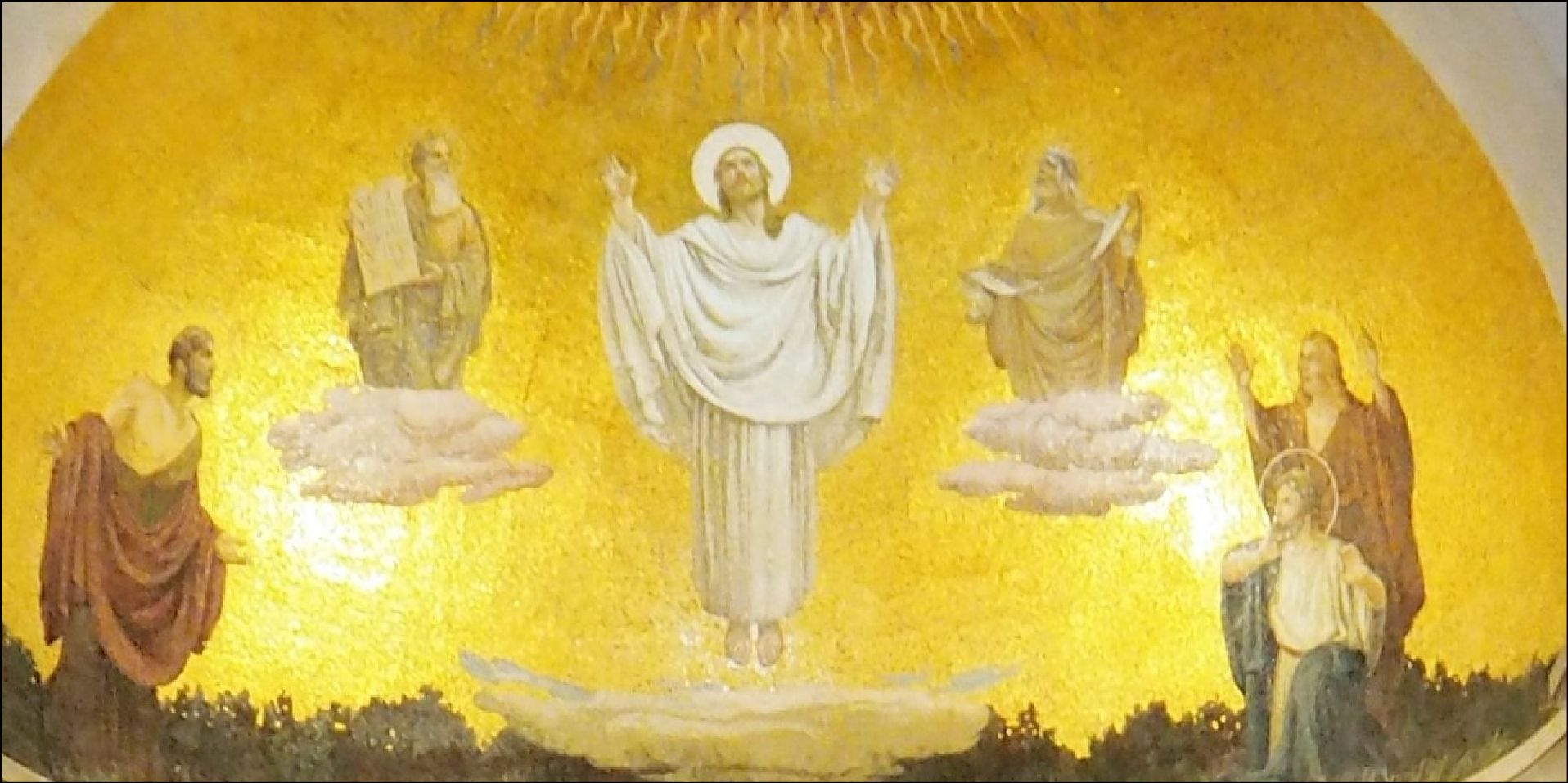
On one occasion before the Resurrection, the disciples were able to glimpse more directly the full truth about Jesus. This happened to his three closest friends, Peter, James, and John, and it is called the Transfiguration. While praying with him on the top of Mt. Tabor near Galilee, Jesus appearance suddenly changed: “his face shone like the sun and his clothes became dazzling white” (Mt 17:2).
For this one moment, the disciples were able to see the divine glory of Jesus in his body. For the rest of the time, Jesus’ divinity was hidden by the “veil” of his fleshly human existence, and only manifested through his miracles and teachings, which are the external signs of his divine power and goodness.
Following the Transfiguration, as they came down the mountain, Jesus forbade the three from telling anyone what they saw, until after his resurrection. It was important for God-Incarnate to “empty” himself of divine glory so that He might assume the lowly form of man (cf. Phi 2:6-7). In fact, God went so far in hiding Himself that even His human form became so disfigured by the agony of His crucifixion that He was barely recognizable even as a man.
Before that disfiguration of humanity by sin and the cross, Jesus showed his disciples what transfigured humanity looks like: what man looks like when he is full of grace and glory. The Church Fathers taught that God became man so that man could become God! What they meant is that Jesus came in order to transform our human nature to be like his own, transfigured in glory. Jesus gave a brief glimpse of what his body would be like after the Resurrection, and therefore what our bodies will be like on the final day of Resurrection when there is no more sin and death, no more disfigurement.
The Transfiguration is therefore a vision of hope and encouragement as we have to take up the cross. It is a mystery of Christ that is intended for the Church. Jesus said, “he who eats my flesh and drinks my blood has eternal life, he will never die, I will raise him on the last day” (Jn 6:50,54). Through Baptism, Confirmation, the Eucharist, and all the Sacraments, we also have the divine life of God in us. Like Jesus, we also have – in an invisible but real way – the glory of eternal life in our body, a power greater than death and disfigurement. It is a very real truth, even though we cannot see it with our eyes.
Although, every once in a while, like the Transfiguration, we might be given a small glimpse of this divine life shining through our weak human nature. The saints are examples of how the light of Christ and glory of the Holy Spirit dwelling within, shine forth through our “faces” and “clothing” (Mt 17:2).
The face represents the person. We shine forth the glory of Christ in our face when we, as persons, are conformed to Christ so fully that others may recognize the mercy of Christ in our eyes, and his charity in our smile.
The clothing represents the external trappings of our life; i.e. our lifestyle. We shine forth the glory of Christ in our clothing when our life is one of order, harmony, and peace, filled with activities that are noble, worthy, and beautiful. Others, seeing how we live and present ourselves through a Christian culture, marvel at the goodness of God.
During Lent, we focus on this process of transformation. We allow our face to shine with God’s glory by turning from sin and living our true dignity as sons of God. And we allow our clothing to shine with God’s glory by turning away from activities and entertainment that are useless, keeping a home that is clean and ordered, and balancing our time with prayer and work.
By looking to the Lord’s Transfiguration, we see our own future in the resurrection of the dead, and dedicate ourselves to the spiritual work that will lift us from the deformity of the world to the holiness of heaven.