True Lord
3rd Sunday of Lent (A)

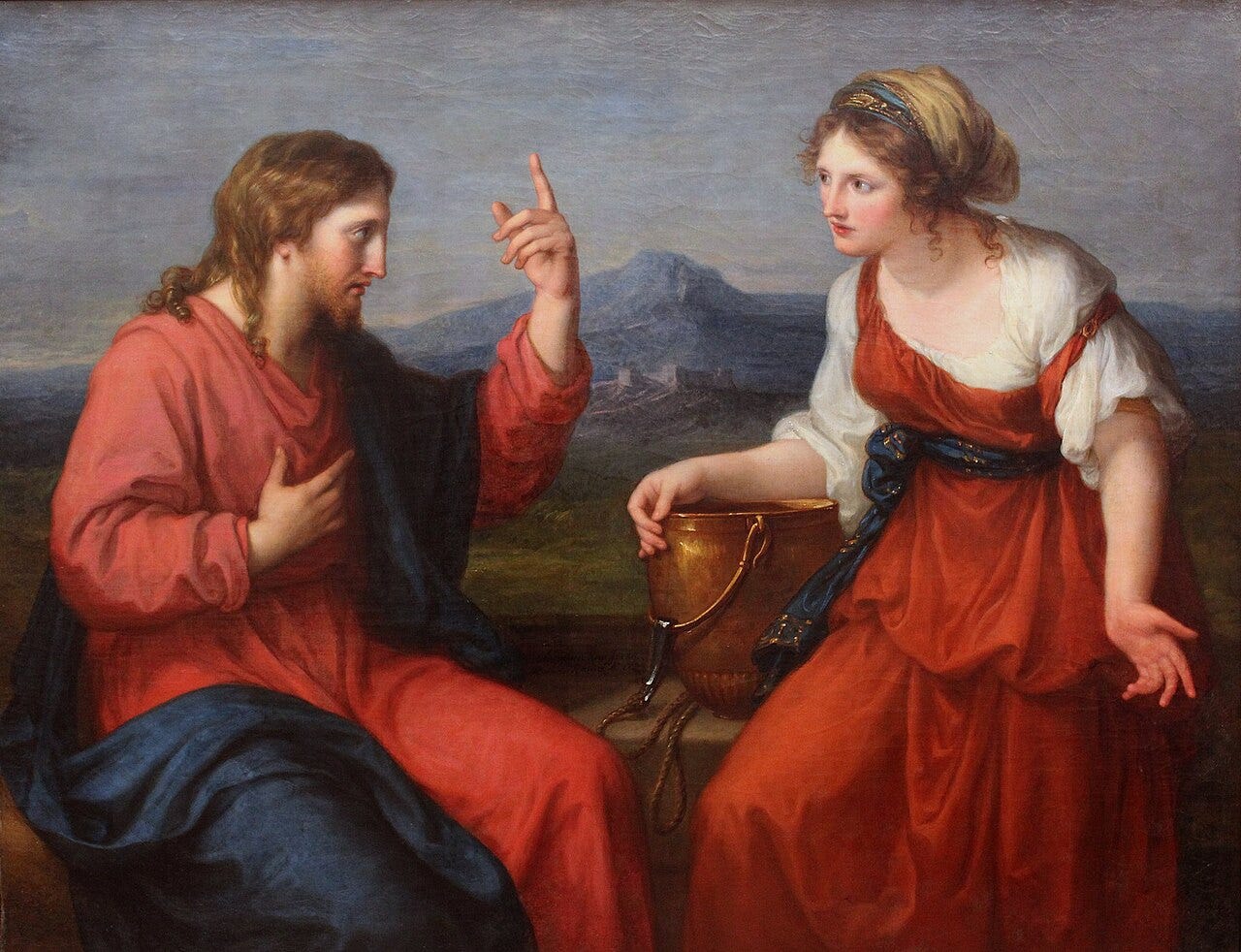
Sychar is a little village located between Jerusalem and Galilee. It is near the ancient Biblical town of Shechem, where there was a famous well dating from the time of the patriarch Jacob. This region formerly belonged to the ancient tribal lands of the northern 10 tribes, now long gone. In the time of Jesus, the area is known as Samaria. The people who live there, called “Samaritans,” have a religion that is mostly pagan, with some vestiges of Israelite beliefs mixed in.
Returning to Galilee from one of his pilgrimages to Jerusalem, Jesus passed through Samaria, and arrived in the little village at noon in the heat of the day. He was hungry, tired, and thirsty, and sat down by Jacob’s well as his disciples went into the village to buy food.
On the first Sunday of Lent, we saw Jesus in the desert, hungry and thirsty after 40 days of fasting, being tempted by the Devil to fill himself with bread. Jesus resisted the temptation, knowing that “man does not live on bread alone.” In the story of the Samaritan woman, Jesus also ends up not eating or drinking, even though he is hungry and thirsty (in the end, the woman runs back into town leaving her water jar by the well, never having given Jesus a drink!) And when the disciples return with food urging him to eat, he tells them, “I have food to eat of which you do not know” (Jn 4:32).
Jesus is hungry and thirsty in his human body. But he is also hungry and thirsty in his soul. Jesus is hungry for our love, he is thirsty for our faith; only that satisfies him. When the Samaritan woman responds to him with sincere, genuine, and simple faith, Jesus is nourished and refreshed.
Faith and love are more nourishing than bread and water. The human being needs faith and love more than the basic necessities of the body. When a society abandons itself to drugs, immorality, and chemicals to satisfy its needs, it means the society is spiritually empty. It has lost God.
Our society is just like that of the Samaritans. Like the Samaritans, our society is quite religious, but like the woman in the Gospel, modern religion is confused, combining some elements of truth with many pagan practices. The Samaritan woman argues with Jesus about who has the true religion, the Samaritans or the Jews, just as people today bicker about which religion to follow. There may be some vestiges of true biblical beliefs left today, but it is confused and mixed with paganism.
Jesus highlights this problem: “You have been married five times, and the man you are now living with is not your husband.” He is not only calling her to review her life and the sinful mistakes of her past, he is also pronouncing an indictment on Samaritan society and calling the people to follow the true faith.
In that region, pagans used to worship five false gods, called “Baals.” “Baal” is the Aramaic word for “lord” or “husband.” Worshipping a false god is a kind of spiritual adultery: one is accepting a false lord in one’s life. After having worshipped false pagan gods, the Samaritans were still not worshipping in spirit and truth. Jesus affirmed that “Salvation comes from the Jews,” and in fact, he presents himself as the true Bridegroom, the true Lord that people must follow.
Likewise we today worship false lords: money, pleasure, convenience, chemicals, and vanity; and many Christians do not faithfully follow true Biblical teachings. For instance, like the woman in the Gospel, people today go in and out of many relationships, even though they call themselves Christian and are very religious in other ways.
Today, Jesus passes through our modern world, our society, our nation, our city. And he is thirsty. There is an ancient well in our modern world like Jacob’s well – the Catholic Church and our Christian Faith are that wellspring of Eternal Life. They are ancient sources of truth from a distant religious past, and people still come to them to drink, but many are not being satisfied anymore. And the reason is because they have lost commitment, and are not being true to their baptismal consecration anymore. They don’t know the One whose well it is, the One who is asking for a drink and who alone provides living water. They are not being satisfied, because even though they come to the well, they are not worshipping the Father “in Spirit and Truth.” They are trying to be religious, while actually giving themselves to other husbands, living according to a pagan lordship and worldly masters.
Jesus wants us to stop worshipping the Baals, the false idols; he wants us to worship the Father, through himself. Like the Samaritan woman, Jesus wants us to stop giving ourselves to false husbands, whether this means relationships that are not true marriage, or whether it means attachments to things of this world, which cannot satisfy the soul.
Jesus wants us to turn away from sin, and from trying to satisfy our hunger with the world. Bread and water can briefly take care of the body’s needs. Drugs and alcohol and uncommitted relationships seem to satisfy for a while, but they cannot overcome the emptiness in the soul. Our spirit hungers for God, our soul thirsts for Christ’s love. We must renounce the false baals, and accept Jesus as our true Lord.
Lent is a time for us to hear again the call to conversion, which means divorcing from false gods even though they promise many things, and coming back to the true God, through Jesus Christ, in hunger and thirst. He says to us: “Give me a drink” (Jn 4:7). By allowing him first to quench our thirst with the Living Water that is himself, in a response of sincere love and faith, we give him the gift which in turn satisfies his thirst.