Until Death Do Us Part
32nd Sunday in Ordinary Time (C)

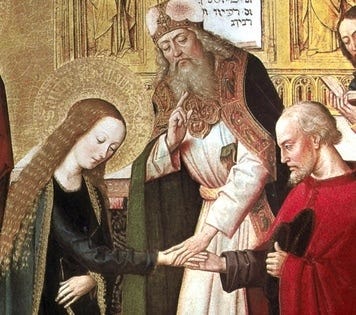
In the Resurrection on the last day, we will live in a body that is no longer subject to the limitations of this mortal life. The body will no longer experience the possibility of death. It will not hunger or thirst. And, as Jesus explains to the Sadducees, it will no longer have the need of marriage (Lk 20:35).
This teaching has great significance for this mortal life prior to death and resurrection, because it clarifies more fully the final end. God’s “end-game” for His work of creation is what we call “heaven.” God is crowning Himself with creatures, both angelic and human, who reflect and add luster to His glory. Heaven will include a physical component, the “new earth” (Rv 21:1).
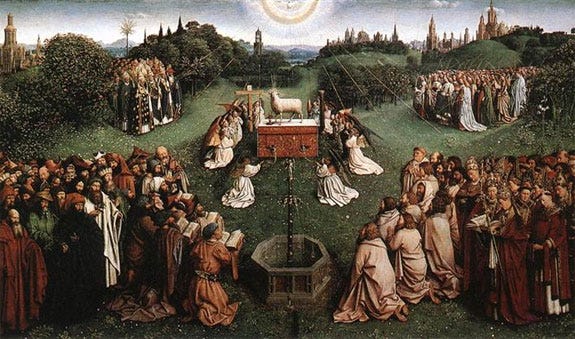
The work will come to its completion when the full number of souls has been reached, a number which God alone knows. In the case of the pure spirits (the angels), God creates them directly. But in the case of human spirits, God creates them by means of human participation. This is the purpose of marriage.
There are several secondary purposes or “ends” of marriage, such as the well-being of the couple, the reflection of Christ’s union with his Church, and the reflection of Trinitarian love, but all these build on the fundamental reason for being “male and female” in the first place: to procreate children: “male and female He created them. And God blessed them saying, ‘Be fruitful and multiply’” (Gn 1:27-28).
When they marry, the couple says, “until death do us part.” They are not merely promising to be faithful and committed to each other for the rest of their lives, they are also acknowledging that their marriage is limited “this age” (Lk 20:34) before death. In the next age, their marriage will give way to something greater: a union with God, both physical and spiritual. “Until death do us part” really means “Until Resurrection do our purpose complete.”
We must allow the Gospel to shape our way of thinking about life, and marriage. We must reject the idea that the family should be deliberately “limited” in size, or that “career” can be more important than “family.” On the contrary, recognizing that our purpose here in the body is to be fruitful and multiply, cooperating with God in bringing forth the full number, we should embrace the mission of having as many children as possible, and carefully raise them in the Kingdom of God so that none will be lost to that final glory.
All other work and accomplishments of man will pass away with his death. But the new souls he helped procreate will never pass away, they will be part of the eternal structure of heaven. The “work” of this age is to prepare for the next by completing the full number of souls necessary for the City of God. All have a responsibility to share in this mission, whether married or not.
Those called to marriage have a solemn responsibility to be generously open to life. It is wrong for a married couple to deliberately limit the number of children they intend to have, without just cause.[1] It is sinful to prevent pregnancy by artificial means of contraception, and it is sinful to be deliberately sterilized.[2] Those called to the sacrament of matrimony have a mission and responsibility, using the gift of this time on earth to contribute as much as possible to what heaven will be. Married couples unable to have children of their own, may discern other pathways to build the Kingdom of God, such as legal adoption. God has so arranged our circumstances that in some situations there will be abundance, while in others there will be limitation.
Those who are not married also share the responsibility of the marital mission, albeit in secondary ways. For the young, there is the responsibility to prepare well for their own future marriage. For the elderly, there is the responsibility to help with raising and forming grandchildren. Those called to celibacy for the sake of the Kingdom, or to Consecrated Virginity, have a unique spiritual charism to constantly remind the world that its true destiny is found only in the Resurrection on the last day.
Others who are not called to marriage (Mt 19:11-12) are still called to help bring new souls to heaven by supporting the marital vocation in their families and among their friends. They must not live in a way that violates the law of marriage, but instead use the freedom of being single to assist others, and support the work of the church more directly with energy and resources. There is a particular need for those unable to marry due to homosexual inclination, not to withdraw into a separate “subculture,” but rather to participate fully in the common lifestyle of prayer and fraternity that is family-oriented and serves the Kingdom of God. There is no exception to being man or woman as determined by God, though there is often need for healing in the struggle to love purely.
It is the doctrine of the Resurrection of the Dead that helps married couples appreciate their vocation, which can often last 50 years or more. It is this doctrine which gives meaning and urgency to all the vocations, which one way or another are oriented to the mystery of final union with God.
[1] A just cause might include, for instance, health reasons.
[2] Tubal ligation, vasectomy.